Today, we are announcing updates to the AWS Well-Architected Framework with new and improved guidance across its six pillars, Operational Excellence, Security, Reliability, Performance Efficiency, Cost Optimization, and Sustainability. The Framework now separates account- and organization-level best practices from workload best practices, so you can establish foundational guardrails in the environment where your workloads run. New best practices address secure coding, cyber resilience for backup data, generative AI for operational efficiency, and measuring resource efficiency, so the Framework reflects how teams build and operate in the cloud today.
A brief history
The AWS Well-Architected Framework is a collection of best practices that organizations of every size and industry use to design, build, and operate workloads that are secure, reliable, high-performing, cost-effective, sustainable, and straightforward to operate.
We launched the first version of the Framework in 2012. Since then, it has grown from a single set of guidance into a full body of architectural knowledge. We published the AWS Well-Architected Framework whitepaper, added the Operational Excellence pillar, and released pillar-specific whitepapers and AWS Well-Architected Lenses for specific technologies and industries. Next, we refreshed the Framework so that best practices became the core unit of guidance, and we added Sustainability as the sixth pillar. As customers began building with generative and agentic AI, we introduced new lenses to guide them. In 2026, the Framework continues to change to help customers build and run secure, resilient, efficient, and sustainable workloads in the cloud.
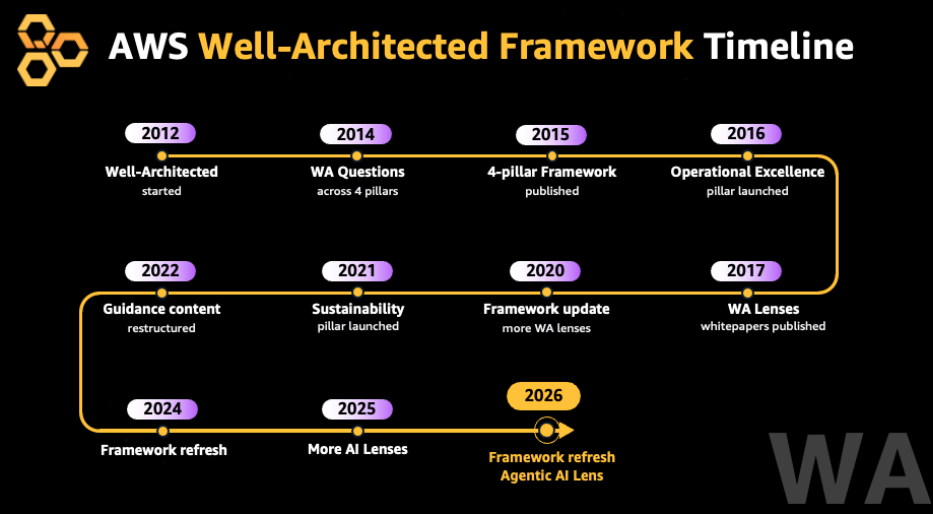
Figure 1: AWS Well-Architected guidance timeline, 2012 to 2026.
What’s new
Customers tell us they value Well-Architected reviews and want a more efficient way to run them. Account- and organization-level best practices apply across the entire environment, so customers want to assess them once and then focus each review on the workload itself. To streamline reviews, this release organizes the Framework into two areas, Well-Architected Cloud Foundations and Well-Architected Cloud Workloads. As a result, a workload review covers only the best practices that apply to that workload, which makes it faster to run and automate.
Well-Architected Cloud Foundations covers environment-wide decisions, such as multi-account structure, identity, and cost governance. It sets the guardrails that every workload inherits, and you refine them as your environment matures. Well-Architected Cloud Workloads covers how you design, build, and operate each workload, including updated architecture patterns focused on specific business outcomes. In both areas, best practices are organized into capabilities, which are groups of related best practices that share a common objective.
This release focuses on technical architecture. As more teams use AI agents to run reviews, guidance is most useful when an agent can check it against how your environment and workloads are built and operated. Best practices centered on business strategy, people, and organizational processes depend on human judgment and context that are not captured by configuration or telemetry. Mixing these elements with technical guidance makes it more difficult to automate reviews. We retired these best practices, and AWS continues to offer guidance on these topics through other resources. Each remaining best practice now addresses a technical decision that you, or an agent acting on your behalf, can review and act on.
We also updated service references throughout the Framework, removing services that no longer accept new customers or have reached end of support, and adding guidance for services launched since the last release.
Well-Architected Cloud Foundations
Best practices for account- and organization-level decisions were previously spread across the Framework and reviewed for every workload. Well-Architected Cloud Foundations consolidates them into guidance you apply when you set up or mature your multi-account environment. Of the best practices in Well-Architected Cloud Foundations, 33 come from moving or merging existing best practices from the Framework pillars.
We consolidated and rewrote the relocated best practices from an environment-wide perspective, then combined them with newly authored foundational guidance. That guidance includes new best practices for centralized event monitoring, an auditable cloud inventory record, and centralized DNS management. The result is 45 best practices across seven capabilities: Multi-account environment, Identity and access management, Central observability management, Resource and inventory management, Security and compliance, Cloud financial management, and Networking and connectivity.
Well-Architected Cloud Workloads
Well-Architected Cloud Workloads now has 216 best practices, down from 307, with no loss of technical coverage, so each workload review stays focused on its architecture decisions. Practices that apply across your environment moved into Well-Architected Cloud Foundations, practices with similar guidance were combined, and practices outside the technical scope of the Framework were retired.
Operational Excellence
Operational Excellence introduces new capabilities and best practices that follow the operations lifecycle, which covers observation, deriving insights, managing change flow, deployment, support, response, and evolution. It adds a new best practice for managing rollouts of external dependencies and expands guidance on using AI assistants and agents to instrument telemetry, draft dashboards, and investigate incidents, with validation against baselines and named human ownership at every step.
Security
Security moves account-wide concerns, such as root account protection, sign-in mechanisms, permission guardrails, emergency access, centralized logging, and forensic readiness, into the Identity and access management and Security and compliance capabilities of Well-Architected Cloud Foundations. Within Well-Architected Cloud Workloads, the pillar adds new best practices for centralized workload permissions management, detection metrics and dashboards, and secure coding guidelines.
Reliability
Reliability moves three networking best practices (IP subnet allocation, hub-and-spoke topologies, and non-overlapping address ranges) into the Networking and connectivity capability of Well-Architected Cloud Foundations, where they are consolidated into a single network strategy best practice. Within Well-Architected Cloud Workloads, the pillar adds a new best practice on cyber resilience for backup data, which helps protect backups against ransomware and other cyber threats.
Performance Efficiency
Performance Efficiency moves its best practice on policies and reference architectures into Well-Architected Cloud Foundations. Within Well-Architected Cloud Workloads, the pillar now focuses Architecture selection on validating your workload requirements and tracking them with key performance indicators (KPIs). It also combines related best practices, such as folding compute configuration into compute selection and load testing into workload performance evaluation.
Cost Optimization
Cost Optimization moves its best practices on account-level concerns, such as account structure, cost attribution, billing tools, and cost controls, into Well-Architected Cloud Foundations, where they form the core of the Cloud financial management capability. Within Well-Architected Cloud Workloads, the pillar combines overlapping best practices, such as merging its decommissioning guidance into a single resource lifecycle management best practice. It also adds a new best practice on using generative AI for operational efficiency.
Sustainability
Sustainability introduces new capabilities and best practices that follow how teams reduce workload impact, which covers measuring and monitoring, provisioning resources, improving workload efficiency, and optimizing data and processing. Based on customer feedback, earlier general guidance has been converted to best practices. It adds a new best practice for using the most resource-efficient computational approach, including using a less resource-intensive method or a smaller machine learning model where one meets the requirement. It expands guidance on combining resource usage efficiency metrics with carbon emissions data from the AWS Sustainability Console / API and AWS Data Exports, with baselines and targets that make progress measurable over time.
Call to action
AWS Well-Architected Framework is more than a set of best practices and tools for finding improvement opportunities. It is a mechanism that helps you strengthen governance and drive better outcomes across your organization. When you evaluate your architecture consistently against best practices, you build a culture of continuous improvement and address critical issues before they affect your workloads. Ready to get started? Explore the updated AWS Well-Architected Framework, soon to be available in 11 languages: English, Spanish, French, German, Italian, Japanese, Korean, Indonesian, Brazilian Portuguese, Simplified Chinese, and Traditional Chinese.


