China’s homegrown memory comes largely from two companies, CXMT for DRAM and YMTC for 3D NAND, and both are booming. CXMT’s Oct. 30 quarterly report shows a nine-month net profit of ¥132.0 billion ($19.6 billion), against a ¥5.28 billion ($785 million) loss a year earlier, on revenue more than eight times as high, at ¥269.0 billion ($40.0 billion). YMTC’s numbers, just for Q1, are at ¥47.04 billion ($7.0 billion) in revenue and ¥33.38 billion ($5.0 billion) in profit attributable to shareholders, more than double 2025.
Both are expanding and adding fabs, and each is edging into the other’s products. No Chinese manufacturer can yet produce high-bandwidth memory (HBM) in volume, though. HBM is the stacked DRAM that AI accelerators depend on, and currently the U.S. bars Samsung, SK hynix, and Micron from selling it into China. CXMT’s prospectus lists no HBM project, though its HBM3E is reportedly in risk production, an early run before the process is fully qualified. Huawei designs its own HBM but doesn’t say who makes it.
Memory is a commodity, so the story is in the wafers. We cover the companies running memory fabs in China: CXMT, YMTC, a handful of smaller Chinese fabs, and Samsung and SK hynix, which run some of their biggest plants there. Huawei makes the cut for its HBM program, though it has no memory fab. Fabless designers, module makers, and NOR flash producers are left out, except XMC for its HBM line. Fab counts, products, and financials come from filings and company statements; capacities, planned fabs, and the HBM progress that remains the big question mark rest largely on anonymous reporting. Let's dive into the current state of the Chinese DRAM industry.
CXMT: three DRAM fabs running, three more on the way
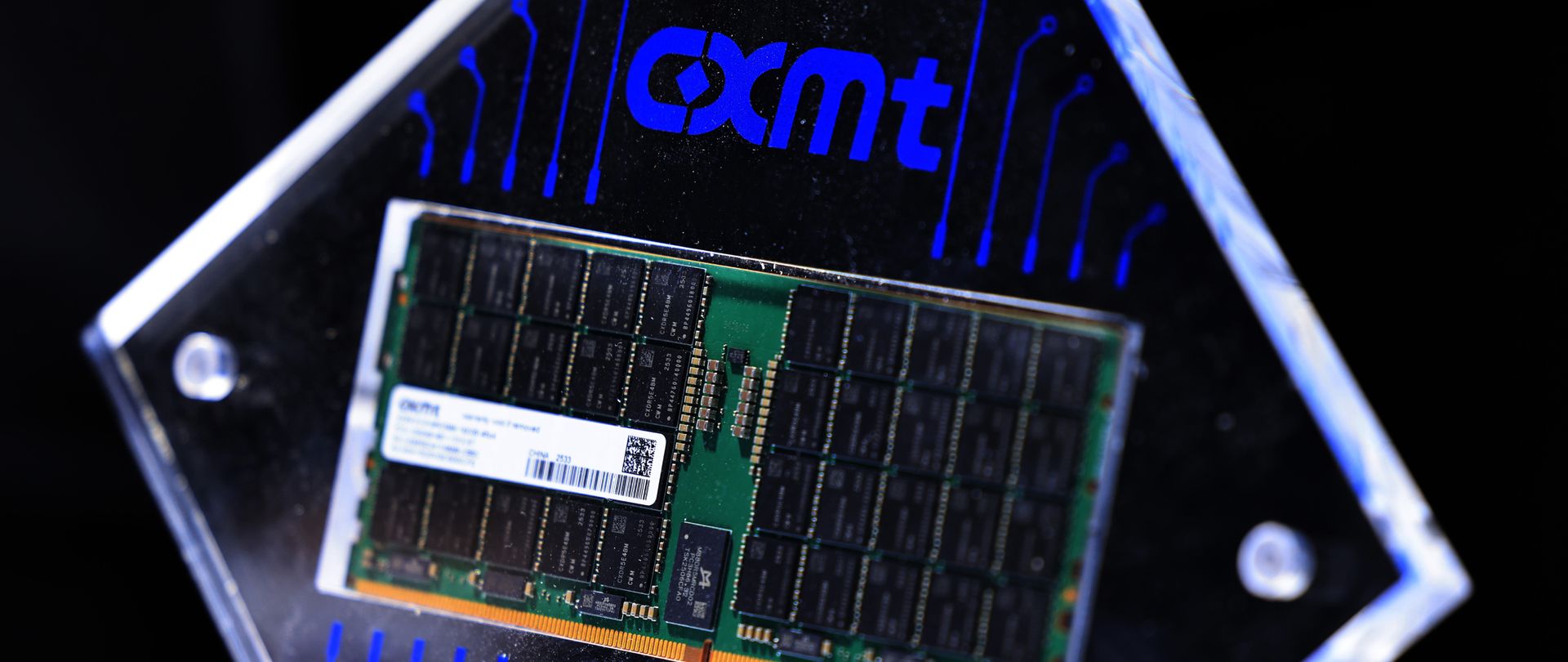
CXMT, short for ChangXin Memory Technologies, is China’s biggest homegrown DRAM maker. It operates two 12-inch fabs in Hefei and one in Beijing, each able to produce around 100,000 wafers a month. It is also building fabs in Shanghai and Hefei and is in funding talks for a second Beijing fab, which together could take it past 600,000 wafers a month. The Shanghai fab is expected to have two to three times the capacity of the Hefei base, with tools going in during the second half of 2026 and volume in 2027.
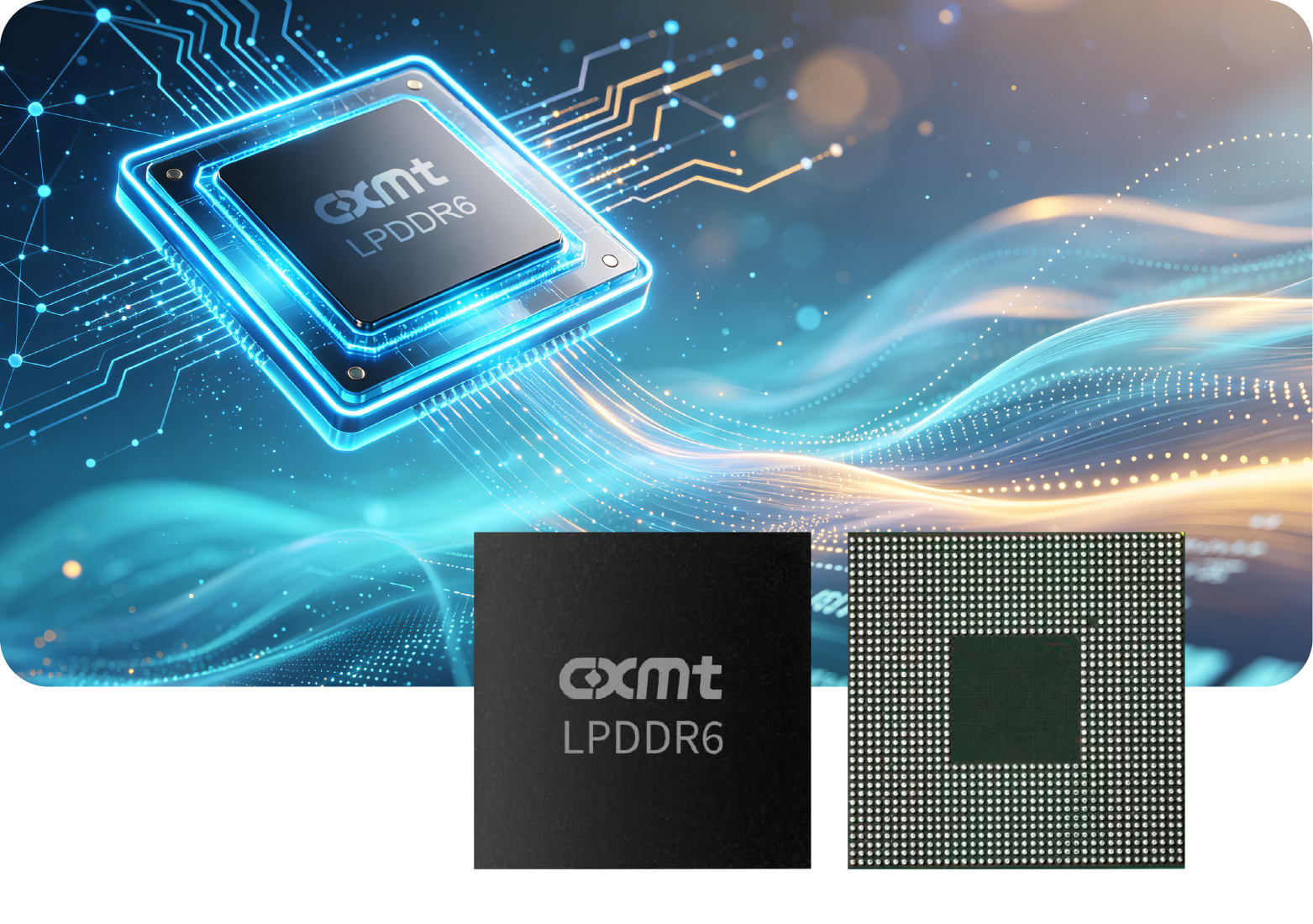
CXMT is now the fourth-largest DRAM maker worldwide, with 9.5% of DRAM revenue in Q2, according to TrendForce. CXMT says LPDDR6 is in mass production for Xiaomi, and its president says the first 4F² product, a server DDR5 RDIMM, is due by year-end. This comes after record first-half revenue of ¥150.3 billion ($22.4 billion), net profit of ¥77.6 billion ($11.5 billion), an 84.84% gross margin on its main business, and a listing on Shanghai’s STAR Market on July 27. Third-quarter profit alone was ¥54.4 billion ($8.1 billion).
The primary products are DDR5 rated up to 8,000 MT/s with 24Gb dies, and LPDDR5X rated up to 10,667 MT/s. CXMT says its fifth-generation G5 platform reaches 11.95nm active-area half-pitch with quadruple patterning for 24Gb LPDDR5X, and gets at least 50% more dies out of each wafer than G4, counted as 8Gb dies. CXMT says a DRAM product on its sixth-generation platform has also completed engineering-sample validation. Jeongdong Choe, Senior Technology Fellow at TechInsights, told Tom’s Hardware Premium that the firm measured the smallest active half-pitch on CXMT’s G4 at 14.8nm and hasn’t analyzed G5 yet.
CXMT lists no GDDR or 3D NAND among its products and is limited to nodes made without extreme ultraviolet (EUV) lithography as it lacks the tooling. CXMT’s second Beijing fab, however, is planned to include a 3D NAND R&D line, which could shake things up. The growth picture for now is capacity and price, with the tests of scaling without EUV lying with the RDIMM and Shanghai fab.
YMTC: going all out on NAND, DRAM in testing
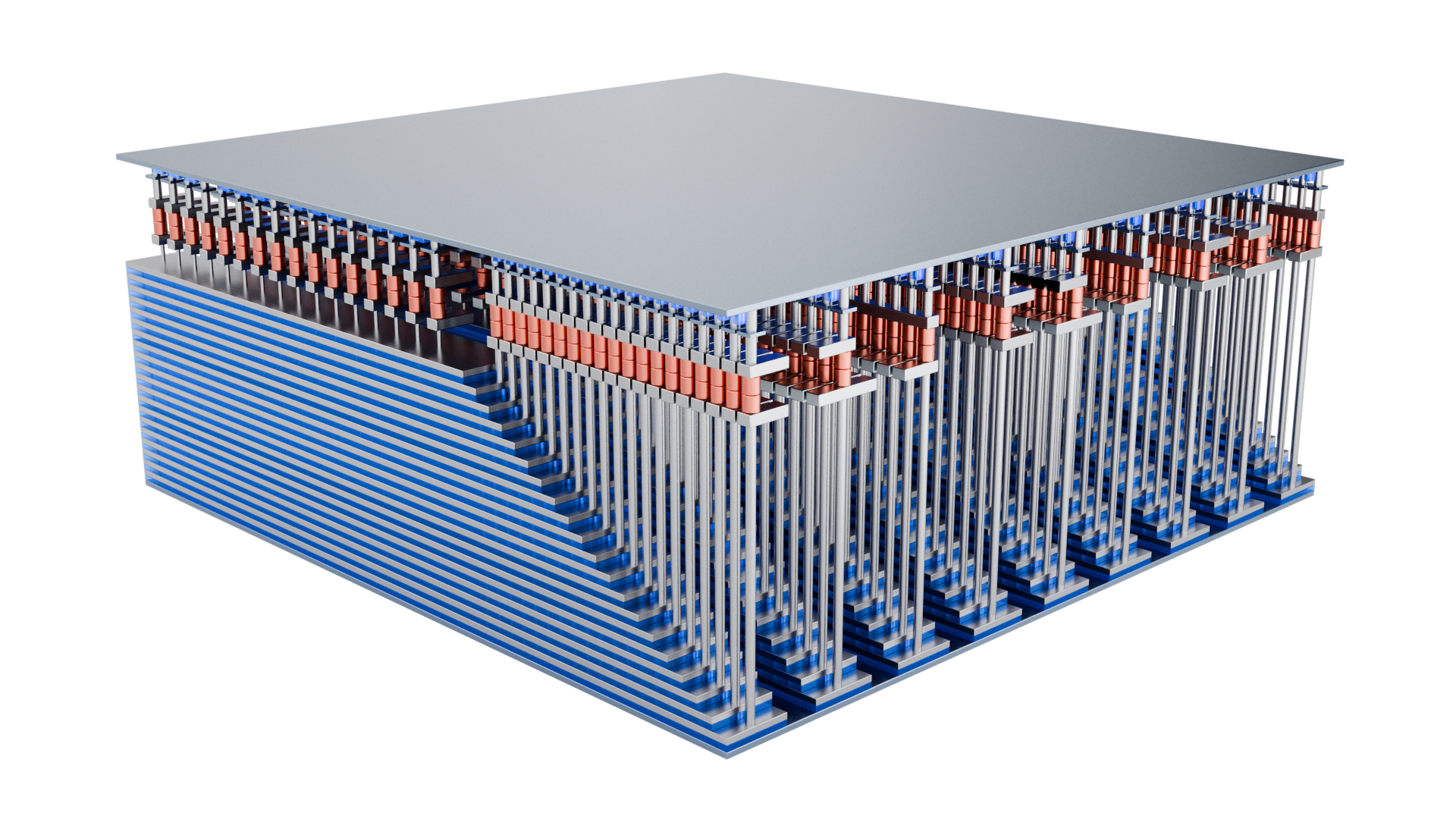
YMTC, short for Yangtze Memory Technologies Co., has two fabs of its own in Wuhan, which can produce about 200,000 wafers a month together. A third fab in the Xinzhou district, registered in September last year, is expected to produce about 50,000 wafers a month by 2027 and eventually 100,000 at full capacity. While YMTC is known for its NAND flash, roughly half of Fab 3’s output is earmarked for DRAM. The company also makes enterprise SSDs and UFS and eMMC parts, and sells consumer SSDs under its ZhiTai brand. YMTC filed its own STAR Market prospectus, to match CXMT’s, on Aug. 21.
NAND flash was, until recently, the star of the show for Chinese memory, and YMTC’s Xtacking technology is one reason why. Its fifth-generation Xtacking 4.0 die, used in 1Tb TLC and 2Tb QLC parts, has 294 gates, and Choe told us 267 of them are active word lines. Most of what YMTC ships, however, is still 160- and 232-layer NAND. Samsung licensed YMTC’s Xtacking bonding patents in February 2025, so the technology could be considered both proven and valuable.
Omdia data put YMTC at 38.5% of China’s NAND market in Q2, ahead of Samsung’s 33.5%. Globally, YMTC ranked third in NAND shipments in Q2, according to Counterpoint Research, and its share of NAND revenue rose from 9% to 14% between Q1 2025 and Q1 2026. YMTC’s stated long-term targets are about 20% of global NAND supply and about 500,000 wafers a month, DRAM included.
For DRAM, YMTC’s Fab 2 is running about 5,000 wafers a month of 16Gb LPDDR5, still in R&D and testing, with no plan for mass production. However, a 9,600 MT/s part on a vertical channel transistor (VCT) 4F² cell is slated for mass production at Fab 3 if it passes qualification. XMC, YMTC’s former foundry unit, left its control in July.
The smaller fabs: Jinhua’s DDR4 and SwaySure’s unfinished line
Two smaller fabs worthy of note are Fujian Jinhua and SwaySure. The former has a 12-inch fab in Jinjiang, which produces custom DDR4 on 25nm, at 40,000–50,000 wafers a month, with about 90% going to Huawei. DDR4 prices have surged this year, by as much as 50% in the first quarter alone, as the big suppliers wind DDR4 down in favor of server and HBM parts and enterprise buyers stock up.
SwaySure, a Shenzhen company founded in March 2022 with state-owned investment, is building a 28nm 12-inch DRAM line and is reportedly backed by Huawei. Analyst Jim Handy of Objective Analysis doubts the 28nm line could make HBM. Neither company responded to our requests for additional information.
Company | Fab (location) | Makes | Notably doesn’t make | Status |
|---|---|---|---|---|
CXMT | Hefei Phase 1 and Phase 2 (Anhui); Beijing (Yizhuang) | DRAM | GDDR, 3D NAND, HBM in volume | Producing; about 100,000 wafers a month each |
CXMT | Shanghai DRAM fab | DRAM for servers, PCs, and cars, plus HBM lines | — | Under construction; volume in 2027 |
CXMT | Shanghai HBM packaging plant | HBM stacking and packaging | — | Under construction; due by the end of 2026 |
CXMT | New Hefei fab; second Beijing fab | DRAM; NAND R&D line planned for Beijing | — | Hefei under construction; Beijing in funding talks |
YMTC | Wuhan Fab 1 and Fab 2 (Hubei) | 3D NAND, TLC and QLC, on Xtacking | DRAM in volume, HBM | Producing; about 200,000 wafers a month combined |
YMTC | Wuhan Fab 3 | 3D NAND; DRAM planned (9,600 MT/s LPDDR5 on a VCT 4F² cell) | — | Equipping; starts late 2026 or 2027; about 50,000 wafers a month by 2027 |
YMTC | Two more fabs, sites not reported | 3D NAND and some DRAM | — | Planned; 100,000 wafers a month each |
XMC | Wuhan, two 12-inch fabs and a reported HBM line | Specialty foundry: NOR flash, MCUs, 3D integration | HBM (a 3,000-wafer-a-month line under construction since February 2024) | Operating; out of YMTC’s control since July 2026 |
Fujian Jinhua (JHICC) | Jinjiang (Fujian) | Custom DDR4 on 25nm | DDR5; HBM unproven | Producing; 40,000 to 50,000 wafers a month |
SwaySure | Shenzhen (Guangdong) | DRAM on a 28nm line, planned | — | Under construction |
HBM: who’s chasing, and who isn’t
Not every AI chip needs HBM. Inference hardware can get by on LPDDR5X, as Axera’s AX8860P does in Sipeed’s MaixStation, or on DRAM bonded straight onto the processor, the approach PieceMakers is betting on. Training-class accelerators like Huawei’s Ascend series still need HBM, though, and since the U.S. banned the export of HBM as of Dec. 2, 2024, China can’t buy it from the big three memory makers.
Even those who can get HBM are seeing heat and yield issues with larger memory stacks, specifically 12-high. SK hynix said on its Q3 2026 earnings call that some customers’ spec changes show “demand is indeed overwhelming supply,” and that lowering the stack is “a strategy to increase the number of cubes that can be obtained for the same capacity.” This mirrors other indicators, including potential Nvidia Rubin Ultra decisions, and it suggests that HBM is in short enough supply that even easier-to-build stacks are in high demand.
CXMT has sampled HBM with Tongfu, and HBM3 built on its 16nm-class G4 node to Huawei. Its HBM3E has now gone to several domestic AI chip designers as samples, with limited production due by the end of 2026, and an expansion expected in 2027. Yields are only about 20% to 30%, though, against about 70% at SK hynix, and in testing the chips performed closer to SK hynix’s HBM3 than to its HBM3E. An HBM packaging plant in Shanghai worth at least ¥17.1 billion ($2.5 billion) is targeted for year-end, with capacity for about 30,000 units a month.
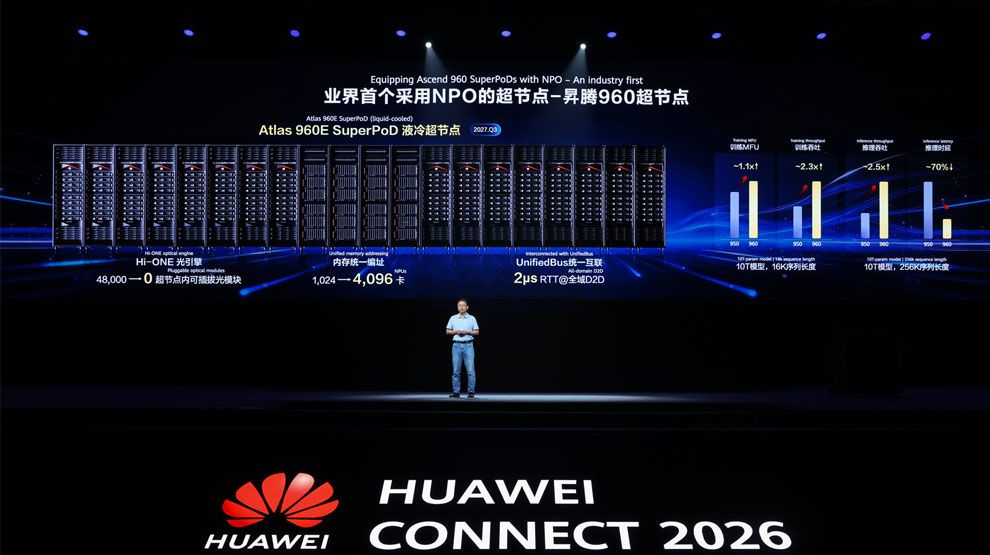
Tongfu reportedly sampled HBM2, but its own filings mention only DRAM and flash packaging. Huawei said last year that “we will offer two proprietary HBMs.” It launched the Atlas 350 card in March, built on the Ascend 950PR, which carries 112GB of HBM. XMC has had a 3,000-wafer-a-month HBM line under construction since early 2024, but no production has been confirmed. At this time, YMTC, Jinhua, and SwaySure don’t appear to make HBM, though reports say YMTC is developing the through-silicon via (TSV) stacking it would need, and Jinhua was named in a Huawei-led HBM group in 2024.
Huawei said in 2025 that the 950PR would use HiBL 1.0, its own “low-cost HBM”; TechInsights told us it hasn’t analyzed HiBL 1.0 yet. However, Huawei’s 2025 roadmap specced out the 950PR's 128GB of HBM at 1.6TB/s. Huawei said that its 950PR is “optimized for the prefill stage of inference,” which is compute-heavy with “lower demand for memory access bandwidth,” and that using HiBL 1.0 is “more cost-effective than HBM3E and HBM4E” for that workload. The higher-end HiZQ 2.0, for the 950DT, is due in Q4 and, by Huawei’s figures, brings 144GB at 4TB/s. In both cases, Huawei’s supplier remains in doubt, and the company did not respond to our requests for comment.
Company | HBM effort | Stage |
|---|---|---|
CXMT | HBM3 and HBM3E DRAM | HBM3 samples to Huawei; HBM3E sampling, with limited production by year-end at 20–30% yields |
CXMT | Shanghai HBM packaging plant | Under construction; due by the end of 2026 |
Huawei | HiBL 1.0, in the Ascend 950PR | Shipping since March 2026 in the Atlas 350 (112GB); maker not disclosed |
Huawei | HiZQ 2.0, in the Ascend 950DT (144GB at 4TB/s) | Due in Q4 2026; maker not disclosed |
XMC | HBM packaging line, 3,000 wafers a month | Under construction since February 2024; production not confirmed |
Tongfu Microelectronics | HBM packaging | HBM samples with CXMT and HBM2 samples reported; filings show only DRAM and flash packaging |
YMTC | None in production | TSV stacking in development |
Fujian Jinhua | Named in a Huawei-led HBM group in 2024 | Unproven |
SwaySure | None known | Doubtful on a 28nm line (analyst Jim Handy) |
Samsung, SK hynix, Micron | Can’t sell HBM into China | Barred by the U.S. rule of Dec. 2, 2024 |
The foreign fabs, and the restrictive rules
Of the companies from outside China, Samsung and SK hynix both run large memory fabs on Chinese soil, and both are now upgrading their NAND lines there. Samsung’s Xi’an handles about 40% of the company’s NAND, including 236-layer, or V8, in volume, with X2 converting to 286-layer, or V9, this year, slated to reach 5,000 V9 wafers a month in December and 40,000 by December 2027. A Samsung spokesperson told Tom’s Hardware Premium that the company “has been transitioning its existing manufacturing operations in Xi’an to 9th-generation V-NAND in compliance with U.S. export regulations and in close communication with the U.S. government.”
SK hynix’s Wuxi produces 30–40% of its DRAM and has moved from 1z to 1a, with the EUV layers done in Korea. Dalian turns out about 100,000 wafers a month of 192-layer floating-gate NAND and is moving to 240 layers, the most SK hynix is authorized to make there.
SK hynix, which already sells NAND with up to 321 layers elsewhere, told us it needs a U.S. license every year and declined to give product details or capacities for individual fabs. The company said that it intends for its 321-layer flash to be “over 50% of domestic (Korean) capacity in the fourth quarter,” which puts the Dalian lag into relief.
SK hynix also has “Mod B,” a second fab at its Dalian site that was completed in 2023. The company has reportedly tied a new U.S. NAND fab to Washington, letting it ship more U.S. tools there: Dalian’s 2026 license capped its equipment, no 2027 license had been issued as of mid-October, and its U.S.-based Solidigm unit has applied for an export license to buy more tools for Mod B. SK hynix told Tom’s Hardware that “no capacity expansion is being sought for the Dalian Mod B” and has been installing equipment at its Dalian factory.
Solidigm is now reportedly in talks with the U.S. Commerce Department over a $45 billion chip plant in the U.S., but wants Washington’s approval to ship equipment to upgrade the Dalian plant first, arguing that the upgrade would help finance the new site. However, SK hynix denied an earlier report of such a deal and says no specific plans have been finalized.
As for its Chongqing packaging plant, SK hynix told us it is “exploring various strategic options to enhance our packaging competitiveness,” though nothing is final. Elsewhere in China, Samsung’s Suzhou plant handles assembly and testing, and Micron’s Xi’an site handles packaging and testing.
All of this plays out inside a U.S.-China fight over chips that AI has only sped up. CXMT isn’t currently on the Commerce Department’s Entity List, which bars U.S. suppliers from shipping to listed companies without a license; YMTC, Jinhua, and SwaySure are. Jinhua has been on the list since 2018; SwaySure joined in December 2024 over its Huawei links, and YMTC was added in December 2022.
CXMT is, however, on the Pentagon’s 1260H list of Chinese military companies, which it is suing over. It’s been on the list since January 2025 and stayed on with the June update. For Samsung and SK hynix, the validated end-user status that let both firms ship in U.S. tools was revoked as of Dec. 31, 2025. Annual licenses are now required, and the Commerce Department has said it doesn’t intend to license capacity expansions or technology upgrades. Meanwhile, both companies say upgrades are under way, which sits uneasily with that policy.
China, for its part, has been weighing broader technology export controls and has now proposed adding 40 technologies, reportedly including some memory-chip design technologies, to its Catalogue of Technologies Prohibited and Restricted from Export. The draft, Announcement 48 from China’s Ministry of Commerce and Ministry of Science and Technology, is open for comment until Nov. 15, and anyone exporting a listed technology must register first.
Owner | Fab (location) | Makes | Share of owner’s output | Status |
|---|---|---|---|---|
Samsung | Xi’an X1 (Shaanxi) | 3D NAND: 236-layer V8; V6 ended | About 40% of Samsung’s NAND (both Xi’an fabs) | Producing |
Samsung | Xi’an X2 (Shaanxi) | 3D NAND, converting to 286-layer V9 | In the Xi’an figure | Converting to V9; 5,000 V9 wafers a month in December 2026, 40,000 by December 2027 |
SK hynix | Wuxi (Jiangsu) | DRAM, mostly 1a; EUV layers done in Korea | 30% to 40% of SK hynix’s DRAM | Producing |
SK hynix (Solidigm) | Dalian Fab 1 (Liaoning) | Floating-gate 3D NAND, 192-layer, moving to 240 | About 100,000 wafers a month; 30% to 40% of SK hynix’s NAND | Producing; upgrading, authorized up to 240 layers |
SK hynix (Solidigm) | Dalian Mod B (Liaoning) | 3D NAND, if equipped | Not stated | Built in 2023; SK hynix says no expansion is sought; no 2027 license yet |
Currently, China’s homegrown memory hinges on two manufacturers that are, admittedly, booming at the moment, although the memory industry worldwide has seen a massive surge since spring 2025. SK hynix said that “our DRAM and HBM volume for the next three years through 2029 are effectively sold out” with supply failing to keep up with demand as “a constraint projected to continue through 2030.” Its average selling prices rose from Q2 by mid-20% for NAND and high-20% for DRAM.
There may be some signs of at least temporary cooling in China’s consumer channel, though, as China Flash Market reports that SSD prices fell across the board this week, with most spot NAND wafers trading more than 30% below suppliers’ official prices. It looks like supply will remain a hot topic and China’s production capabilities are front and center.
CXMT and Huawei both have HBM milestones due by year-end: CXMT’s limited HBM3E production and Shanghai packaging plant, and Huawei’s 950DT with HiZQ 2.0. YMTC’s Fab 3 is due in late 2026 or 2027, and CXMT’s HBM3E expansion is expected in 2027. That leaves little time to ramp within 2027, especially at CXMT’s current yields, so we’re skeptical of volume HBM from a Chinese fab, whether measured against domestic demand or global supply, before 2028. Samsung and SK hynix, meanwhile, still need U.S. licenses for next year to keep tooling their Chinese fabs.