
Get the guide to build your first AI agent directly in your inbox with a newsletter signup:
We are all working with AI agents, and we are all delivering more code than we ever dreamed of shipping when we were working without AI.
But there's a common pattern for all developers that I know, myself included: we are all more tired.
How is it possible that now that we are not deep down in the code editor, now that we can do more with less effort, in the end we end the day more tired?
Let's take a look at where our energy has gone and what we can do starting this week.
👉 If this sounds interesting, subscribe now. 22,000+ engineers are already becoming more productive. Paid subscribers have access to premium resources
Why AI can make you more tired even when it does the work
We have all been promoted to tech leads or managers. Or our work went from writing the code to supervising someone who writes the code.
Before, when we were writing the code, we had natural pauses, like, for example, when we were compiling some projects or running some test suite. But supervising never ends, and I think this is one reason why we feel this "AI Fatigue".
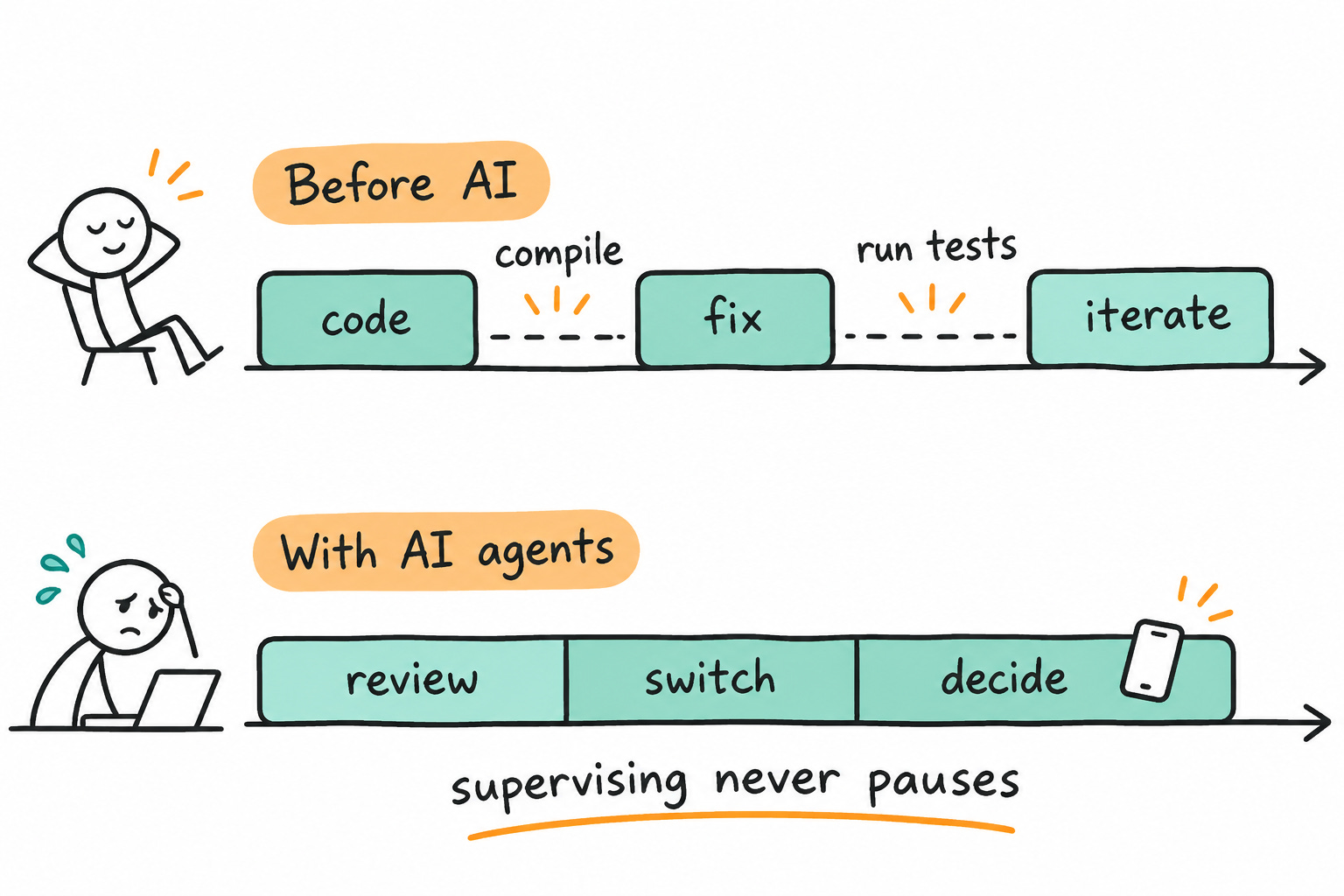
Even if one agent is building a project, you probably have multiple agents working on different things, so there's always something to take a look at.
This is like being the executive who is constantly checking his phone because he has emails and messages about what people are doing in the company around the world.
I know my agents are there, working, even while I commute home, so I'm tempted to check what they finished even during that time.
What the research says about AI fatigue (and what it doesn't)
There are studies that are linking certain AI usage patterns to mental fatigue and decision overload. This is from people's self-reported experience.
And it makes sense because you think that we are working the same hours, but we are delivering more work. So that means that our workday got denser.
And we have to distinguish between being fatigued, being burned out, or having AI brain fry, as some people call it.
Here is how I separate the three terms:
- Fatigue: You are tired after a sustained effort. Sleeping or having a lighter week will help you. This is a symptom that appears after hard and long work.
- Burnout: You are drained of energy, you are cynic of your work, you're feeling less effective. This is a symptom that appears after a long period of time with chronic stress.
- AI Brain Fry: This is the mental fatigue that appears from supervising AI tools frenetically. I got the term from a Harvard Business Review article.
My point is not that AI gives us a new disease. It is that the same tiredness has a new source: not typing, but watching, switching, and deciding all day. If I just feel tired after a hard week of shipping, that is fatigue and a weekend fixes it. If I feel tired, distant, and less effective for months, that starts to look like burnout, and it is worth talking to someone about it. "AI brain fry" sits in between as a name for a specific pattern (too many agents, too many decisions) that researchers are only starting to measure. So I treat it as a useful label and not as settled science.
Where your energy goes: switching, verifying, deciding
Now that we are these AI supervisors, I think that we have some new responsibilities that nobody prepares us for.
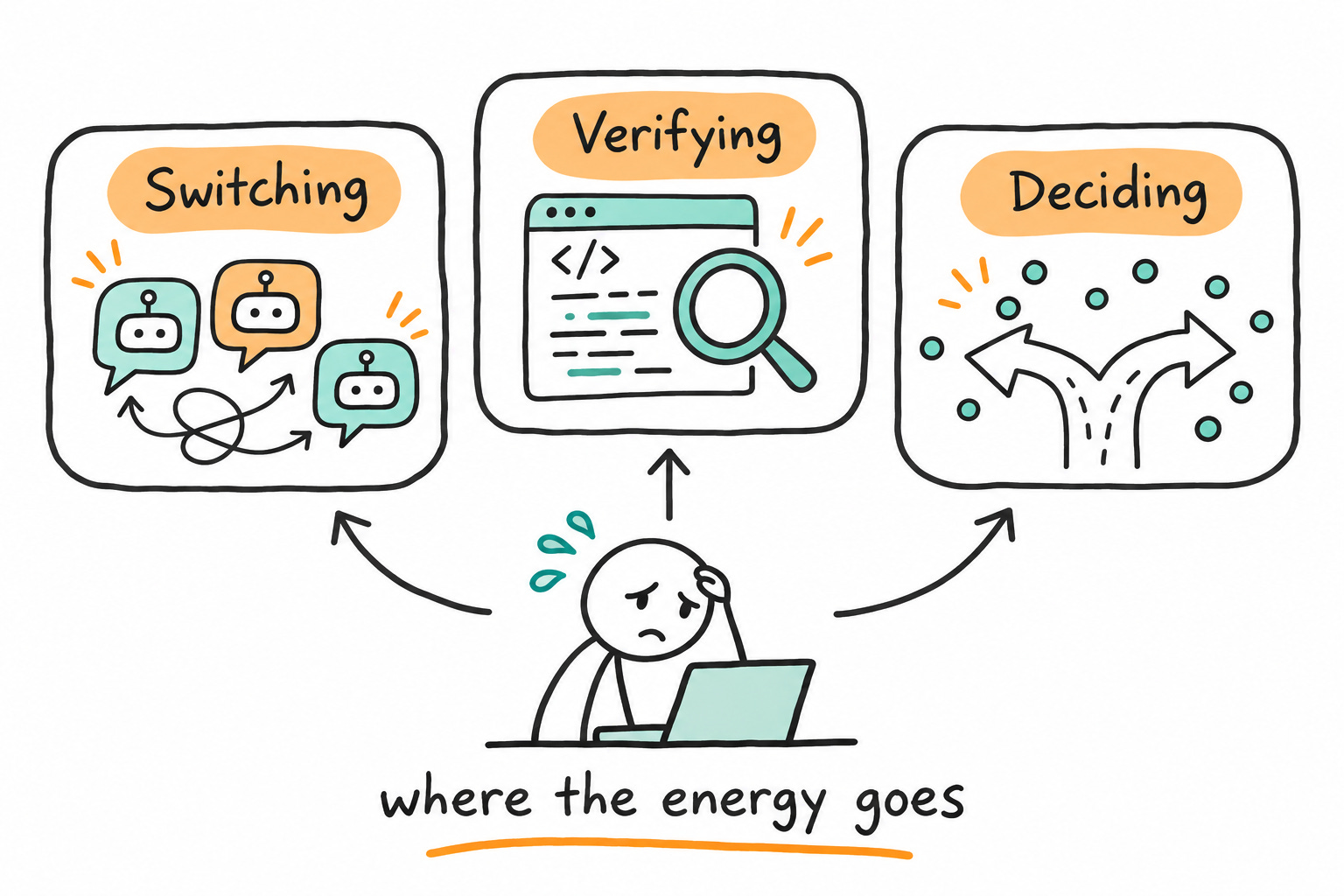
Switching: many tasks in flight
I work with multiple agents, and I think each agent in isolation will think that I'm just stupid. I'm constantly asking "hey, what have we done and what do we still have to do", even if for the agent, I have asked the same a couple of messages ago.
The reality is that we can never sit down for enough time to finish one task, leave it closed, never come back to it, and then move on to the next thing. We have busy work days where we have to keep jumping between work and meetings and messages from people.
This happened already in the past, but in the past I would be working at max on one or two tasks. I would have had agents working in many different directions and in many different projects.
Verifying: reading code you did not write
The main criticism that I have with the AI is that it is an abstraction that allows us to move farther up in the levels of abstraction. But it's a leaky one. I do not have to learn assembly code or care about it because I know that the compilers will handle everything deterministically.
But with AI, even if I create a good process and good skills, I will still have to go into the level of detail of checking the code because AI may write code in a different direction from what I wanted.
This means that I am still reviewing the code. I don't have to review it while the AI is writing it, but I have to review it at the end.
And now that the AI writes code faster and we can work with more agents in parallel, it means that this judgment work about how the code should be is something that I have to do more often, and in a shorter period of time.
Also, even if the AI writes good code, it's hard to know what it tried to do because I'm reviewing at the end. If I didn't provide clear instructions of what I wanted before, I will have to do that thinking anyway when I review the code.
It's definitely easier to review your own work because you have given your brain enough time to comprehend it as you were writing the code than now that we just have to face, in the split of a second, a completely unknown code review.
Deciding: endless cheap options
The fact that we are generating more code with agents and we have multiple in parallel means that we have to make decisions for them frenetically.
What to change this week
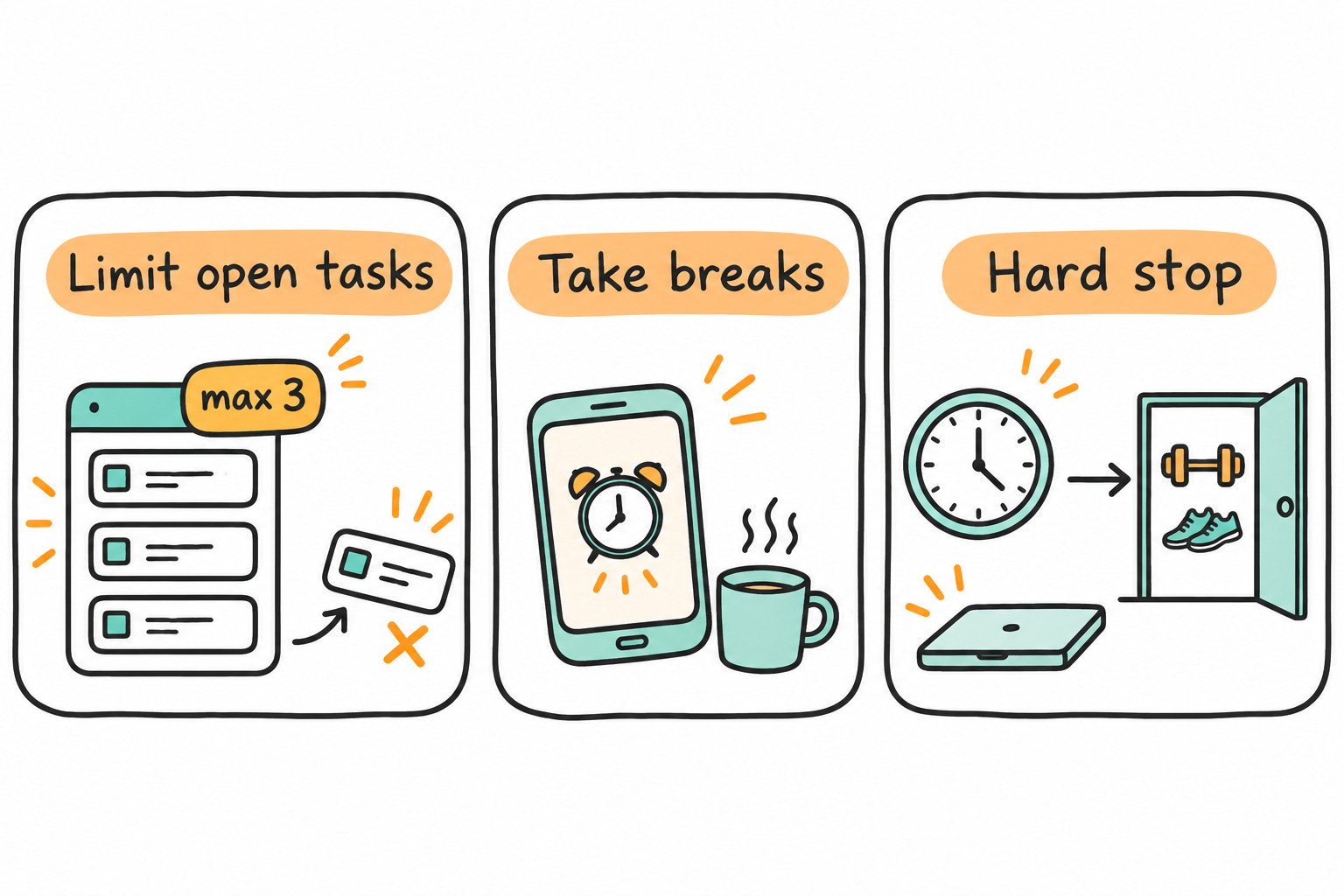
One thing that I really like about the idea of using Kanban methodology is that you cannot have an infinite number of tasks in parallel. So the first change that I would like you to try this week is to keep the number of tasks that you can have open.
This not only applies to your sprint boards but also applies to how many chats you have open with your agent. In how many things is your agent working?
Also, I would suggest that you put an alarm on your phone and take regular breaks. Before I would have a natural break when I had to wait because of waiting for something. But now there's always one prompt to write.
And lastly, a suggestion that I will give you is to put a hard stop. I know some coworkers who intentionally take their gym classes or even dancing classes just after the office. This forces you to make sure that you leave at that time and that you do something that is not related to the computer. Put distance between work and your personal life by doing something scheduled between one and the other.
I know you got this!
If you found value in this post:
- ❤️ Click the heart to help others find it.
- ✉️ Subscribe to get the next one in your inbox.
- 💬 Leave a comment with your biggest takeaway
- ♻️ Share it with your peers
Today’s article helps with phase three of our system, where you use your regained time to build career capital. It shows where supervising AI drains your energy, and three small limits that protect it.
I’m building this system below for paid subscribers. Thanks for your continued support!

🗞️ Other articles people like
What Is an AI Native Software Engineer?
Most engineers using AI today are still operating at the manual prompt level.
Why Open Source Maintainers Are Done With AI Slop
Open source feels broken.
Remove the question tax: Why the best engineers ask more questions
Get the free AI Agent Building Blocks ebook when you subscribe:
Get the free AI Agent Building Blocks ebook when you subscribe:


