Leak TruStream: Two-minute review
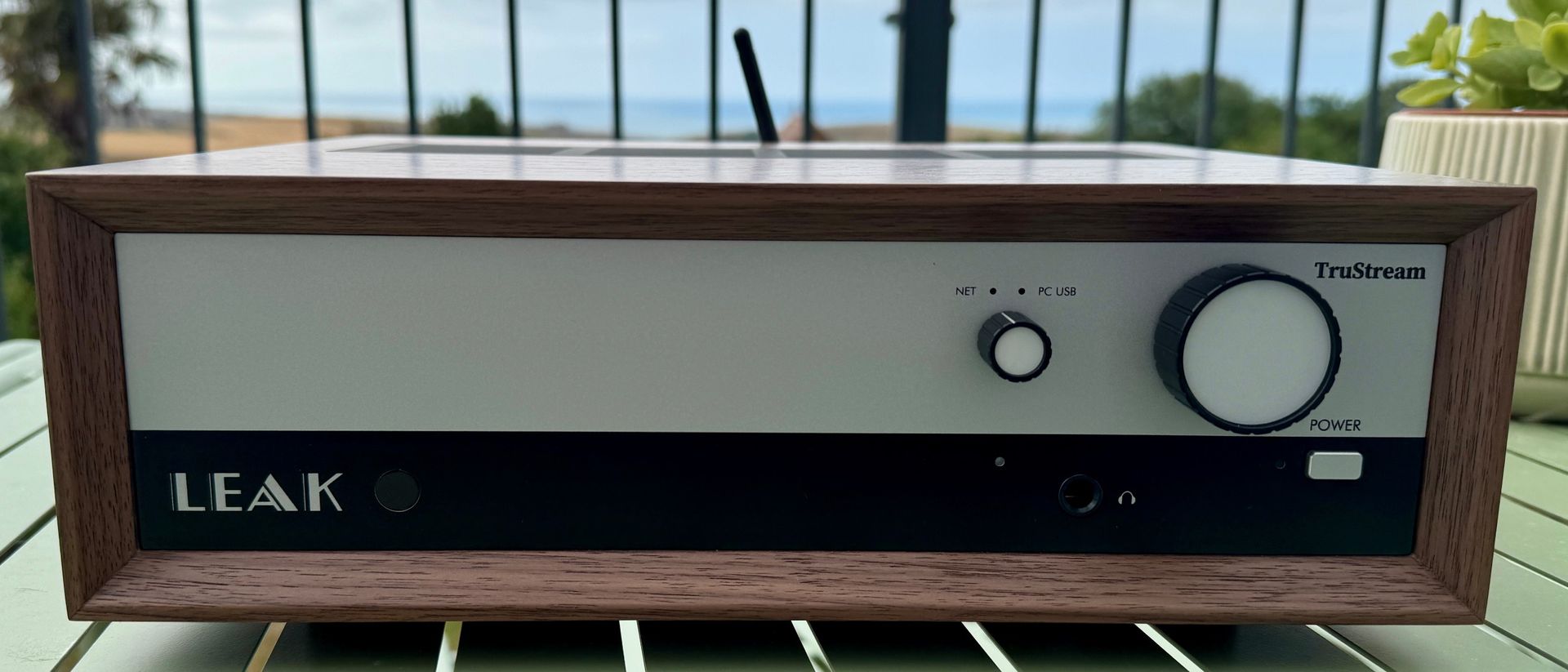
Leak has been doing very nicely as its own tribute act lately, and the latest product to get the ‘walnut and aluminium’ mid-20th century modern retro treatment is a network streamer called TruStream.
But while it looks like a throwback, the TruStream is thoroughly modern on the inside. Wired and wireless connectivity, balanced and unbalanced analogue outputs, a top-end 32bit ESS Sabre DAC and a streaming platform provided by Silent Angel all contribute to a player that’s absolutely got it where it counts. Its control app could learn a thing or two from pretty much anyone else’s control app, mind you…
Given some good hi-res content to deal with, the Leak proves an expansive, detailed listen that controls both the layout of a soundstage and the description of rhythms really well. Its powers of insight and resolution make for an absorbing listen — although the sensation of outright fidelity is undermined just a little by the integrated DAC’s tendency to attack high frequency information a little too readily and by a relative lack of dynamic headroom. But given everything it does well in sonic terms, and given that it’s a visually unique offering in a “me too!” market, don’t be surprised if plenty of people are able to overlook these shortcomings…
Leak TruStream Review: Price and release date
- Launched in April 2026
- Costs $1,499 / £999 / AU$2,199
The Leak TruStream network music player is on sale now having hit shelves in April 2026 for most of us, and in the United Kingdom it costs £999. In Australia it goes for something like AU$2,199, while in the United States it will set you back $1,499 or thereabouts.
And while that's not crazy money in the world of hi-res audio and hi-fi, it's emphatically an investment — and Leak's still up against stiff competition from the likes of Cambridge, with the CXN100, priced at $1,099 / £899 / €1,049 (around AU$1,665).
There's also a November 2026-launch Yamaha dual hi-fi streamer launch to cast your eye over if you're looking for alternatives, starting with the cheaper Yamaha WXC-70, which at the time of writing is due to sell for £859 (about $1,170, AU$1,700), so it's the cheaper of the two models.
Then again, Nagra's Compact Streamer was launched just before the Leak, in March 2026 — and that will set you back a slightly more eye-watering £6,000 / AU$9,495 (around $8,000). So, there's plenty to think about within Leak's chosen territory.
Leak TruStream review: Features
- 32bit ESS Sabre DAC
- Digital outputs as well as balanced and unbalanced analogue outputs
- Silent Angel streaming platform
You’re not short of choice when it comes to network streamers at this sort of money, even if the rest of them don’t have a hint of the TruStream’s visual panache. Good looks will only carry a product a little way, though, so it’s just as well Leak has specified the TruStream to be fully competitive.
The TruStream uses Silent Angel technology for its streaming platform, and that’s an uncomplicatedly good thing. Low-noise digital transmission and stable networking are the foundations of Silent Angel’s reputation, and when you also consider the Leak’s wide compatibility with streaming technologies it looks like a very wise choice indeed. Apple AirPlay 2, ‘Connect’ for Qobuz, Spotify and TIDAL, and TuneIn internet radio are all available, and in addition the TruStream can deal with playback from network-attached devices via DLNA or from physically connected USB drives. By way of an encore, it’s also Roon Ready.
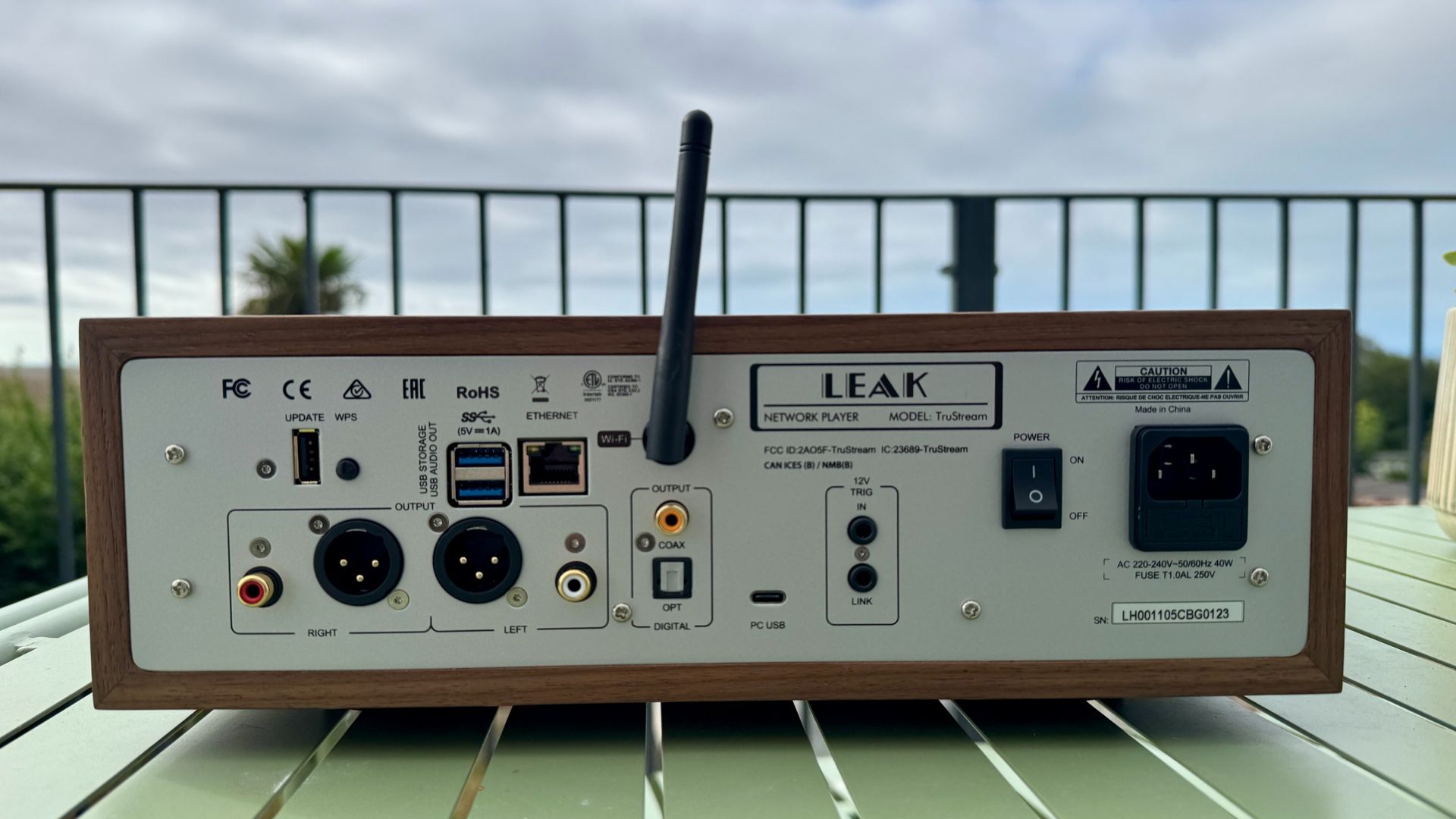
The Leak takes care of the critical digital-to-analogue business with a 32bit ESS Sabre ES9038Q2M DAC chipset. It’s able to deal with every worthwhile digital audio file type (as well as quite a few of the more esoteric alternatives) and can operate at resolutions of up to 32bit/768kHz PCM and DSD512. You can get the information to the DAC using Ethernet, dual-band wi-fi or one of the three USB inputs on the rear of the machine — there’s a USB-C for use with PCs and a couple of USB-A slots for direct connection of storage devices.
You’ve a few options when it comes to getting it out again, too. As well as balanced XLR and unbalanced RCA analog outputs, the Leak also features digital coaxial and digital optical outputs - which is handy on the off-chance you have a more capable DAC somewhere in your system than the one fitted here. There’s also a 6.3mm headphone socket on the fascia, which is powered by a dedicated current-feedback headphone amplifier that’s able to drive even quite tricky loads presented by unhelpful headphones.
- Features score: 5 / 5
Leak TruStream review: Sound quality
- Detailed, organised sound delivered at considerable scale
- Could be more dynamic
- Treble response can be provoked
It’s not, strictly speaking, a game of two halves here — because the things the TruStream gets right outweigh the things it struggles with more than somewhat. Its shortcomings, though, do undermine its overall performance more than a touch - so I may as well start with them before I get into the good stuff.
The Leak is not an especially dynamic listen where the broad strokes of ‘quiet/loud’ and ‘gentle/intense’ are concerned. The two-and-a-half hours of Aphex Twin’s Selected Ambient Works Volume II feature more than a few fluctuations of this type, and while the TruStream is able to make the differences in volume and attack apparent, it doesn’t have the headroom to put proper distance between them. Some similarly priced rivals describe the distance between ‘quiet’ and ‘loud’ in miles, but the Leak measures them in meters.
The same recording reveals its tendency to hit the higher frequencies quite hard, too — or, at least, it does when it’s doing its own digital-to-analog converting. The onboard DAC has a lot going for it — as I will get to shortly — but it’s fairly edgy where treble sounds are concerned and in the wrong circumstances can become quite fierce. A listen to the way the Leak hits the plosives in the vocal during Dalliance by The Wedding Present lets you know what ‘the wrong circumstances’ are.
Elsewhere, though, the TruStream has plenty going for it. The scale of its presentation, for instance, is straightforwardly impressive. It generates a large and persuasive soundstage that manages to incorporate a sensation of ‘front to back’ as well as ‘left to right’. The areas between participants on the stage are described just as carefully as the activities of the participants themselves, and there’s more than enough breathing space available for even the most complex recordings to sound organised and coherent.
Aside from the latent treble issues, there’s a nice neutrality to the tonality and an evenness to the frequency response that’s on display here. At the bottom end the TruStream hits good and hard without being showy about it, and controls the attack of bass sounds with such confidence that rhythms are always expressed in a positive and naturalistic manner. It transitions into the midrange smoothly, and once there it’s perfectly capable of revealing the full range of attitude and character in a vocal performance.
In fact, detail levels are gratifyingly high at every stage — even the most minor occurrences in a recording are picked up on, and the Leak has real expertise when it comes to giving these details the proper weighting and context. It’s particularly adept when it comes to identifying the harmonic variations that come to fore when listening to unaccompanied voice or solo instrument, and those same circumstances also let it highlight its facility with transient information.
- Sound quality score: 3.5 / 5
Leak TruStream review: Design
- 118 x 330 x 288mm (HxWxD)
- A single, quite distinctive, finish
- Goes without a display
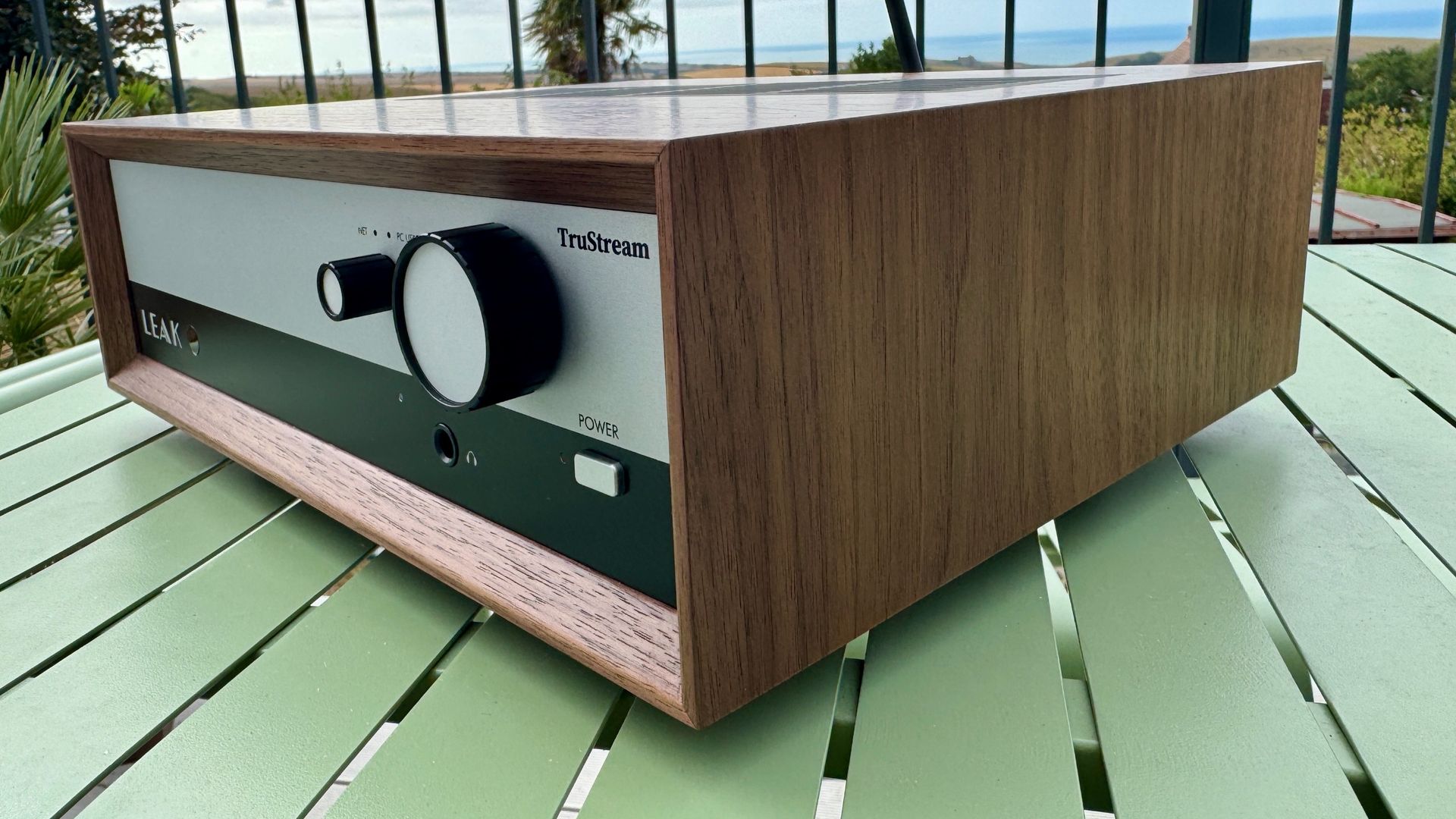
Whoever it was that said “people who like this sort of thing will find this the sort of thing they like” was really onto something. Not everyone will want their network streamer to look like it was designed 70 years ago, of course — but the rest of us will get one look at the diminutive (118 x 330 x 288mm, HxWxD) walnut casework and immediately feel covetous.
The fact that the TruStream is very nicely constructed and impeccably finished, and the aluminium of its fascia contrasts nicely with the wooden panelling - both materials are as tactile as they are visually alluring.
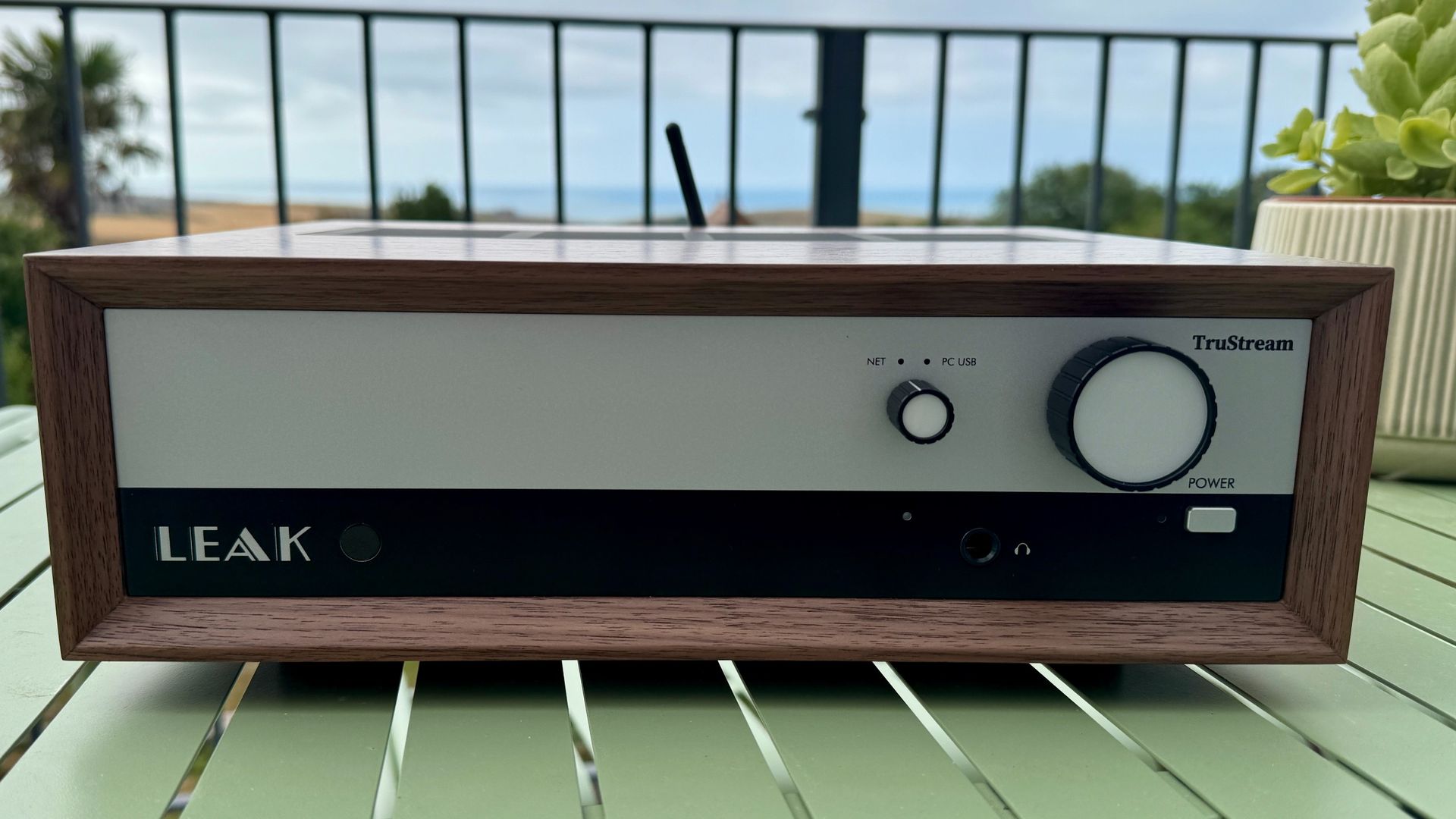
I realise the whole md-century vibe might be compromised by a fascia display, but nevertheless it conceivably puts the TruStream at a disadvantage when you consider the price-comparable rivals that feature quite large, crisp, bright, colourful screens displaying album artwork and what-have-you.
Yes, that information is all available on the device you’re using to stream to the Leak — but ultimately I have to hope the money that has been saved by not implementing any display technology, and the absence of the inevitable electrical activity a display creates inside a streamer, results in a player that outperforms anything of similar price that has one.
- Design score: 4.5 / 5
Leak TruStream review: Usability and setup
- Remote control handset
- ‘Leak TruStream’ control app
- A few fascia controls
Setting up the Leak TruStream is, with one significant caveat, straightforward. It needs to be plugged into the mains, of course, and a physical connection made to the system into which it’s forming a part — all that’s required then is to get it onto your local network and you’re good to go.
But because of the way the ‘Leak TruStream’ control app (which is free for iOS and Android) is configured, this is not as simple as it really should be. It uses a mixture of fonts, all of them rather small and some of them with unnecessary serifs that look fussy and spoil legibility. The occasional use of black type on an orange background is unhelpful too — yes, it passes WCAG (web content accessibility guidelines) standards but is nevertheless difficult to read, especially as those guidelines tend to concern themselves with ‘normal’ and ‘large’ text. The colorblind or otherwise visually impaired will find these elements fatiguing if they can read them at all.
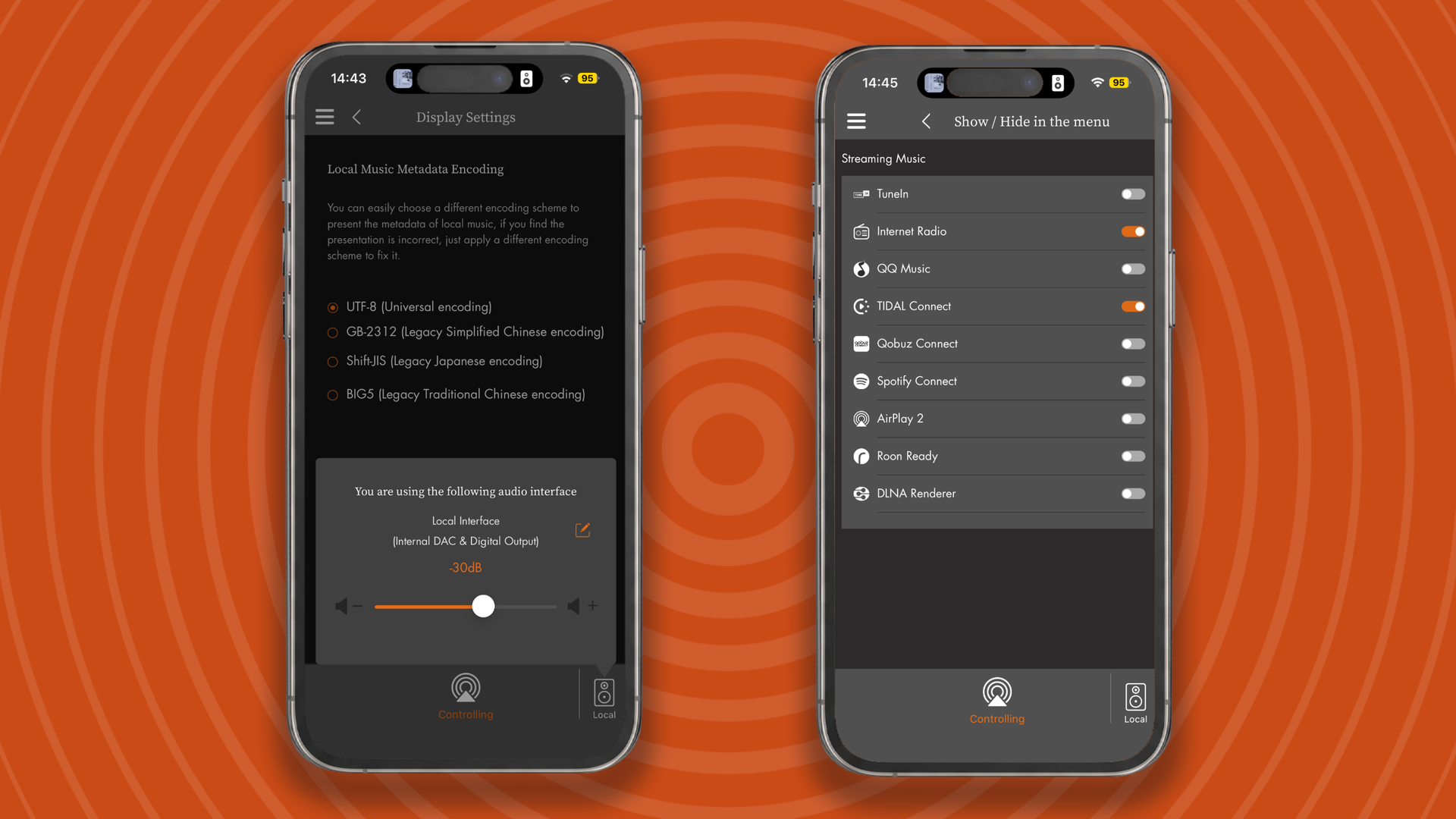
It’s only fair to mention at this point that the app is stable, wide-ranging and does all of the stuff you’d reasonably expect: browse internet stations, check for firmware updates, build playlists and so on, and there’s a degree of home-page customisation available too. But it’s hard to shake the suspicion that this started as a desktop application and has been transferred to mobile devices either on the cheap or in a hurry (or both).
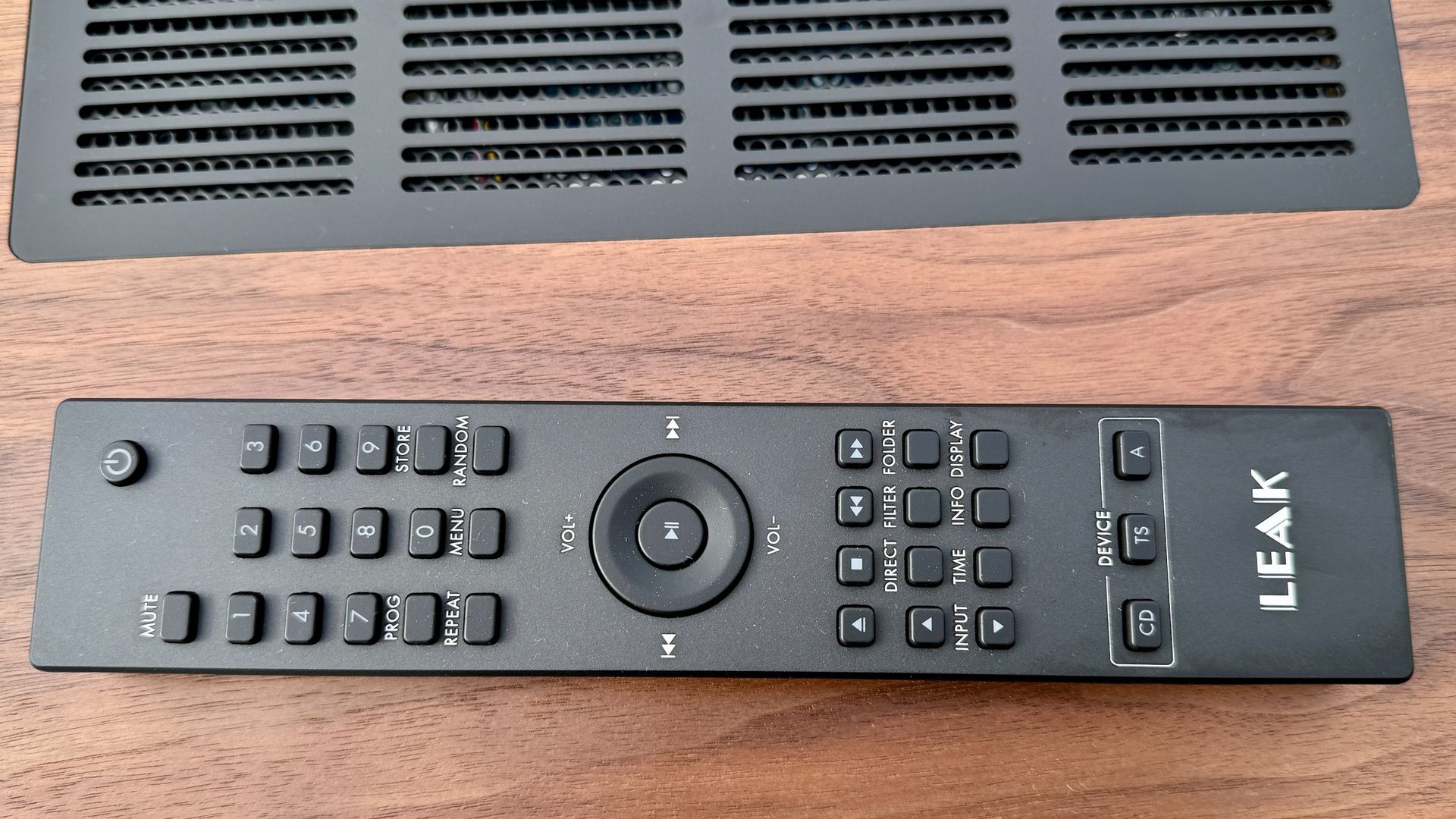
The big remote control handset is a system control, and so the majority of its buttons are surplus to TruStream requirements. Still, it’s a sight more legible than the control app. And the very few fascia controls (power on/off, input selection and volume) feel nicely positive in their action.
The volume control allows the Leak to function as a preamplifier when connected directly to active speakers or a power amp, as long as you don’t mind ‘the system’ consisting of a network streamer — there are no inputs for external source devices, of course.
- Usability and setup score: 3 / 5
Leak TruStream review: Value
If you can put a price on a pleasing aesthetic, on the look and feel of premium materials, and on hard-to-come-by individuality, then the Leak TruStream seems a pretty compelling offering even before you consider the thorough nature of its specification or the sound it makes. And though the sound it produces is not entirely without issues, there’s so much to like about it in sonic terms that it seems likely that many listeners who are sold on the look will reach an accommodation with the slight shortcomings in the sound.
- Value score: 3.5 / 5
Should I buy the Leak TruStream?
Buy it if...
You’re a sucker for the looks
You’re entitled to be excited by the idea of a network streamer that doesn’t just look like every other network streamer
You like to know what’s what
The Leak describes a large and well-controlled soundstage, which makes even tricky recordings easy to follow
You REALLY like to know what’s what
The TruSound is great at revealing the finer details in a recording, which goes a long way to ensuring you’re getting a full account
Don't buy it if...
You know a clear and legible control app when you see one
The ‘Leak TruStream’ control app isn’t particularly either of those things
You hanker after a fascia display
There were no OLED displays in the 1960s, after all, so there’s no way the Leak is getting one
You’re sensitive to high-frequency sounds
The TruStream is not afraid to hit treble information absolutely as hard as possible
Leak TruStream: Also consider
Cambridge CXN100 SE
For £899, you can buy the Cambridge CXN100 SE network streamer, and what it’s lacking in visual pizzazz compared to the Leak TruStream it certainly makes up for elsewhere. A big and bright display, a control app that’s easy to read and slick in operation, an HDMI eARC input for wide system compatibility, and that muscular-yet-delicate sound the Cambrdge has been refining for a good while, all go towards making the CXN100 SE a pretty compelling device.
How I tested the Leak TruStream
I use the TruStream as a source, connected to an Eversolo DAC-Z10 first by its analogue outputs and then by its digital equivalent - which makes assessing the relative quality of the Leak’s DAC straightforward. I also connect it directly to a Cambridge Edge W power amp using its XLR outputs - which means it’s now a preamp as well as a network player. Alternating between wi-fi and Ethernet connections allows access to Qobuz and TIDAL Connect, as well as giving access to a Synology BeeStation Plus (full of very hi-res content) on the local network.
- First reviewed: October 2026
- Read TechRadar's review guarantee


