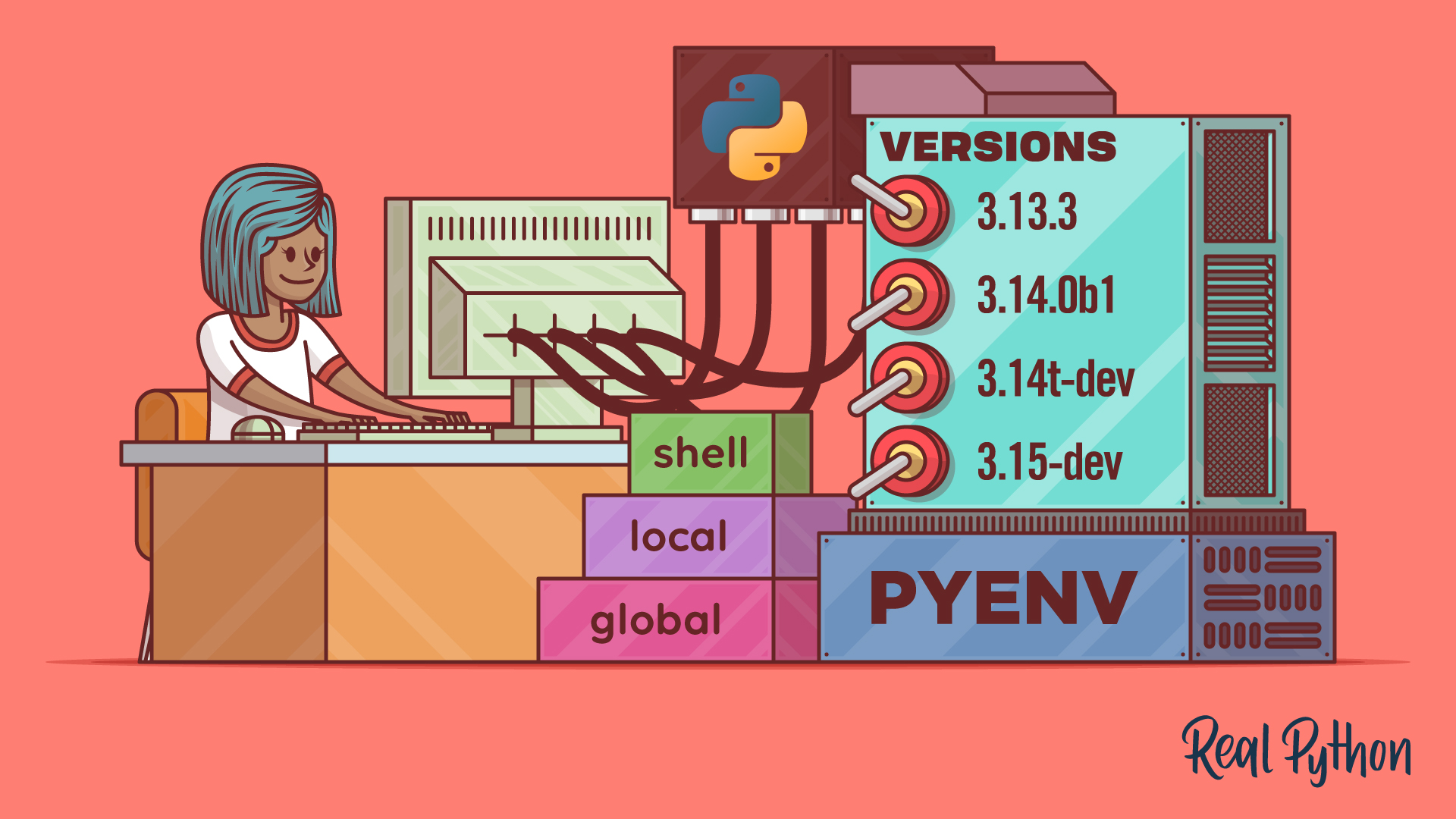
The pyenv command-line tool allows you to install and switch between multiple Python versions without interfering with your operating system’s Python installation. This enables you to test code across different interpreters and manage project-specific requirements.
In this tutorial, you’ll learn how to install and set up pyenv, manage multiple Python versions, and create virtual environments to work on your coding projects.
By the end of this tutorial, you’ll understand that:
- In Python,
pyenvis a command-line tool for managing multiple Python versions independently of your system installation. - The difference between
pyenvand thevenvmodule is thatpyenvallows you to manage multiple Python versions and virtual environments, whilevenvallows you to create virtual environments based on a single Python version. - Using
pyenvhelps you avoid conflicts with your system Python, freely install any Python version you need, and quickly switch between versions for different projects or tests.
Discover how pyenv helps you manage multiple Python versions to prevent conflicts, streamline development, and ensure version compatibility across projects.
Take the Quiz: Test your knowledge with our interactive “Managing Multiple Python Versions With pyenv” quiz. You’ll receive a score upon completion to help you track your learning progress:
Interactive Quiz
Managing Multiple Python Versions With pyenvTest your knowledge of pyenv with this quiz and see how well you can manage multiple Python versions, virtual environments, and dependencies.
Get Your Cheat Sheet: Click here to download a free cheat sheet that shows you how to use pyenv to manage multiple versions of Python.
Understanding the Benefits of Using pyenv
The pyenv tool is designed to manage multiple Python versions in a clean way. Even if you already have Python installed on your operating system, it’s worth having pyenv installed so that you can keep the system Python installation clean and, more importantly, contribute to projects that use a different version of Python.
The question arises: Why would I use pyenv if I already have Python installed on my operating system (OS)?
The system Python installation is the Python interpreter that’s installed directly on your operating system. You’ll typically have a default system Python installation on macOS or Linux. On Windows, you may need to install Python manually.
So, why not use the system’s Python installation for your day-to-day coding? One way to look at it is that this Python belongs to the operating system. In many cases, the OS relies on the preinstalled Python to operate. This means that some OS components may depend on a specific Python version to work correctly. If you change the system Python version or some of the preinstalled packages, you could break the OS itself.
In addition, you may not have much control over what version of Python you can install on your OS. If you want to use the latest features of Python, and you’re on Ubuntu, for example, then you might be out of luck. The available versions might be too old, which means you’ll have to wait for a new OS release to come out. Unfortunately, another Python version can appear in that process, and you’ll never be up to date.
Another issue appears when you install third-party packages on the system Python using the pip command or a similar tool. In this case, you’re installing the Python package globally, which can be a problem if another user—or yourself—wants to install a different version of the package to work on a different project. You can’t have multiple versions of the same package installed in a given Python environment.
For example, if you have version 1.1.0 of a given package and install version 1.2.0, you’ll be replacing the first one. This might seem harmless. However, projects that depend on the older version can stop working with the new version.
A critical issue arises when you have multiple projects requiring different Python versions. The system Python installation is often unique. If you update Python, then some projects may stop working. If you don’t update it, then more recent projects may not be able to use the new features of Python.
Finally, on most operating systems, you need administrative privileges to install a different Python version or third-party packages. This requirement can be a real obstacle in company environments with strict security rules. In short, using the system Python installation comes with some major drawbacks. It can:
- Break parts of the operating system
- Prevent you from using the latest Python versions
- Cause issues in projects that require older Python versions
- Block projects that rely on new Python features
- Require the intervention of a third person when you need to install something
Ideally, you want more flexibility and safety when you use Python for software development. For example, you might need to do some of the following:
- Install Python in your user space so you don’t depend on system administrators
- Install, manage, and uninstall multiple Python versions freely
- Specify the exact Python version you want to use in each project
- Switch between the installed versions
The good news is that pyenv lets you do all these things. It’s also a great way to install pre-release versions of Python, so you can try out new language features or test the release for bugs.
Installing pyenv
Before you install and use pyenv on Linux or macOS, you may need to fulfill some OS-specific dependencies. These dependencies are mostly development utilities written in C that pyenv uses to build Python from source. On the other hand, Windows users set things up differently, as you’ll soon discover.
For a more detailed breakdown and explanation of the build dependencies, you can check out Python Developer’s Guide. In this tutorial, you’ll learn the most common ways to install these dependencies.
Preparing Linux Systems for pyenv
Read the full article at https://realpython.com/intro-to-pyenv/ »
[ Improve Your Python With 🐍 Python Tricks 💌 – Get a short & sweet Python Trick delivered to your inbox every couple of days. >> Click here to learn more and see examples ]