For researchers, manual busywork often eats up time better spent on medical research and scientific writing. Tracking literature scattered across half a dozen apps and a desktop full of PDFs is a monotonous, ongoing task. Before time-sensitive research can begin, scrubbing patient names, dates, and identifiers from clinical data can take months. Most labs treat these tasks as part of the job, but what if they could accelerate the time to discovery?
Dr. Adrienne Kline, a research assistant professor of surgery and electrical engineering at Northwestern University, knows these problems firsthand. Working with Amazon Web Services (AWS), she and her company, Xtasis, built three tools, powered by AI, to solve these time-consuming problems. PixelGuard and NoteGuard mask and pseudonymize identifying information from medical images and clinical notes. CiteGeist manages and verifies the academic literature that researchers rely on. The tools have spread well beyond the walls of Northwestern’s labs, helping research teams worldwide reclaim months previously spent on manual work.
A researcher who builds what her lab needs
Xtasis targets complicated, unglamorous problems clinicians and researchers face daily that few companies have solved well or even tackled at all.
“We’re not interested in chasing the next big trend in AI,” explained Qing Li, chief business officer at Xtasis. “We start with the problems that matter most to physicians, patients, and researchers, then work backward to build thoughtful, comprehensive solutions with trust, transparency, and traceability at its core. Our goal isn’t to create more technology for its own sake but rather to solve problems that have remained unsolved because they demand a fundamentally different approach.”
Kline didn’t build the tools alone. She joined forces with Li and Chris Kuehn, Xtasis’s chief technology officer, combining expertise in research, technology, and business strategy to bring the innovations to market. The team designed each tool to be straightforward and intuitive, so it would work for other institutions and industries, not only Northwestern’s research environment.
AWS got involved early in Kline’s TENSOR lab. An AWS account manager attended one of Kline’s presentations, then reached out to connect. At the ensuing meeting, the AWS team was impressed with Kline’s work and wanted to help her build faster and prepare for scale. AWS also connected Xtasis with AWS Partner ScaleCapacity to migrate her de-identification tools to the cloud. That early involvement helped this small team take PixelGuard and NoteGuard from an idea to cloud-based products that deploy inside a customer’s own environment.
PixelGuard: Sharing medical images without exposing patients
Medical images carry more than clinical data. Patient names, birth dates, and IDs are burned directly into Digital Imaging and Communications in Medicine (DICOM) files and their metadata. Before a research team can use those images, someone must remove every identifier. This manual process can take months, and any identifier that slips through creates compliance exposure under HIPAA or GDPR.
PixelGuard automates that painstaking process while still keeping humans in the loop. It finds and redacts identifying text across ultrasound, MRI, CT, and X-ray images using intelligent, rather than blunt, de-identification. Users then get a traceable crosswalk log to review and validate the changes, with low-confidence changes flagged for closer examination.
Xtasis built PixelGuard with ScaleCapacity as an event-driven application on AWS. The web interface is delivered through Amazon CloudFront and Amazon Simple Storage Service (Amazon S3), and Amazon Cognito handles authentication, including single sign-on. Amazon API Gateway, AWS Lambda, and Amazon DynamoDB store and retrieve metadata. Amazon EventBridge coordinates processing jobs. The de-identification runs in containers on Amazon Elastic Container Service (Amazon ECS) with AWS Fargate, AWS Key Management Service (AWS KMS), and AWS WAF. Amazon CloudWatch handles monitoring and logging, AWS KMS manages encryption keys, and AWS WAF helps protect the web application. De-identification work that used to take months now takes hours or minutes.
Where de-identification happens matters just as much as how fast it runs. Institutions need protected health information (PHI) to stay inside their own accounts, so PixelGuard is available in AWS Marketplace and deploys inside the customer’s environment rather than running as a shared service.
“Every time sensitive data is shared, there is inherent risk. Many of our customers already use AWS themselves, and they value the ability to deploy these products in their own AWS account, where they maintain control of their data and have clear boundaries around where their data resides,” said Kuehn.
NoteGuard: Redacting patient identifiers from clinical notes
Patient identifiers are also present in free-text clinical notes. Teams building large research cohorts, like those funded by the National Institutes of Health (NIH) or pharmaceutical companies, can’t share or train models on notes and images until they’re clean of PHI.
NoteGuard detects and redacts all 18 HIPAA-defined identifiers in clinical notes, each configurable to an institution’s own policy, with one-click audit reporting. Its multimodal date-shifting transformation can work in step with PixelGuard so images and notes from the same patient stay together after de-identification. Because unstructured medical notes are more widely used in research than medical imaging, NoteGuard serves a broader range of researchers than PixelGuard and has already saved hundreds of hours of manual redaction.
After PixelGuard’s success, Kline’s team built NoteGuard on the same AWS foundation, from Amazon Cognito authentication to containerized processing on Amazon ECS with AWS Fargate. NoteGuard is also available in AWS Marketplace.
ScaleCapacity worked alongside Xtasis on both tools, shaping the technical architecture and secure data workflows, defining infrastructure as code (IaC) with the AWS Cloud Development Kit (AWS CDK) for reuse across both products. They also supported the AWS Marketplace publishing process.
“Xtasis brought broad and deep healthcare and AI domain knowledge to the collaboration while remaining highly engaged in the technical and product decisions required to bring that vision to life,” said Ram Dubey, cloud solutions architect at ScaleCapacity. “The teams looked beyond the AI models to consider the complete product experience, from securely handling sensitive medical information and designing HIPAA-aligned workflows to capturing audit information, scaling processing, and making deployment straightforward for customers.”
CiteGeist: Finding, citing, and trusting the literature
Reading, annotating, organizing, and citing academic papers usually means juggling several apps: a PDF reader, a notetaker, a citation manager, and a search tool. Important insights shared among a team can easily get buried within Slack channels and email threads or lost forever in stacks of printed articles and digital archives.
Generative AI tools have complicated the citation step in academic writing. Researchers increasingly use them to speed up writing, but these tools can also invent citations that look real. One audit of published medical papers found thousands with fabricated references. Because newer papers cite older ones, a single fabricated citation can create a cascade over time. A Massachusetts lawyer was sanctioned in 2024 for filing court documents with AI-invented case citations, showing the same failure occurs outside academic research.
CiteGeist brings discovery, stylus notes, tagging, writing stack integration, systematic review support, and sharing into one workspace. Its built-in reference verification tooling validates that references are real and exist. When Kline described her work to Northwestern’s research integrity team, they told her the research community was lucky the problem had landed with someone with the skills to do something about it. CiteGeist has cut the time researchers spend wrangling their literature by roughly 60–75 percent, and it has drawn sign-ups from universities and research institutions worldwide.
Kline and her team built CiteGeist in-house, with architectural advice from AWS. CiteGeist runs using AWS Amplify, Amazon API Gateway, AWS Lambda, and AWS Step Functions. Paper summaries are powered by the NVIDIA Nemotron model through Amazon Bedrock and Amazon SageMaker AI.
A lean team turning research into real-world solutions
Xtasis is a small company, and the three tools were built with a handful of people. That meant making deliberate choices about where engineering time went.
“Building PixelGuard, NoteGuard, and CiteGeist with a small team meant being intentional about where we invested our time and expertise,” said Kuehn. “AWS managed services allowed us to focus on what mattered most: developing tools that solve real problems, rather than managing the infrastructure behind them.”
The same thinking applied to CiteGeist, which the team built without knowing how many researchers would eventually use it.
“With CiteGeist, we didn’t need to anticipate every future demand or build for a scale we hadn’t yet reached,” said Kline. “We could start small, iterate quickly, and have the infrastructure grow alongside our user base.”
That turned out to matter sooner than expected.
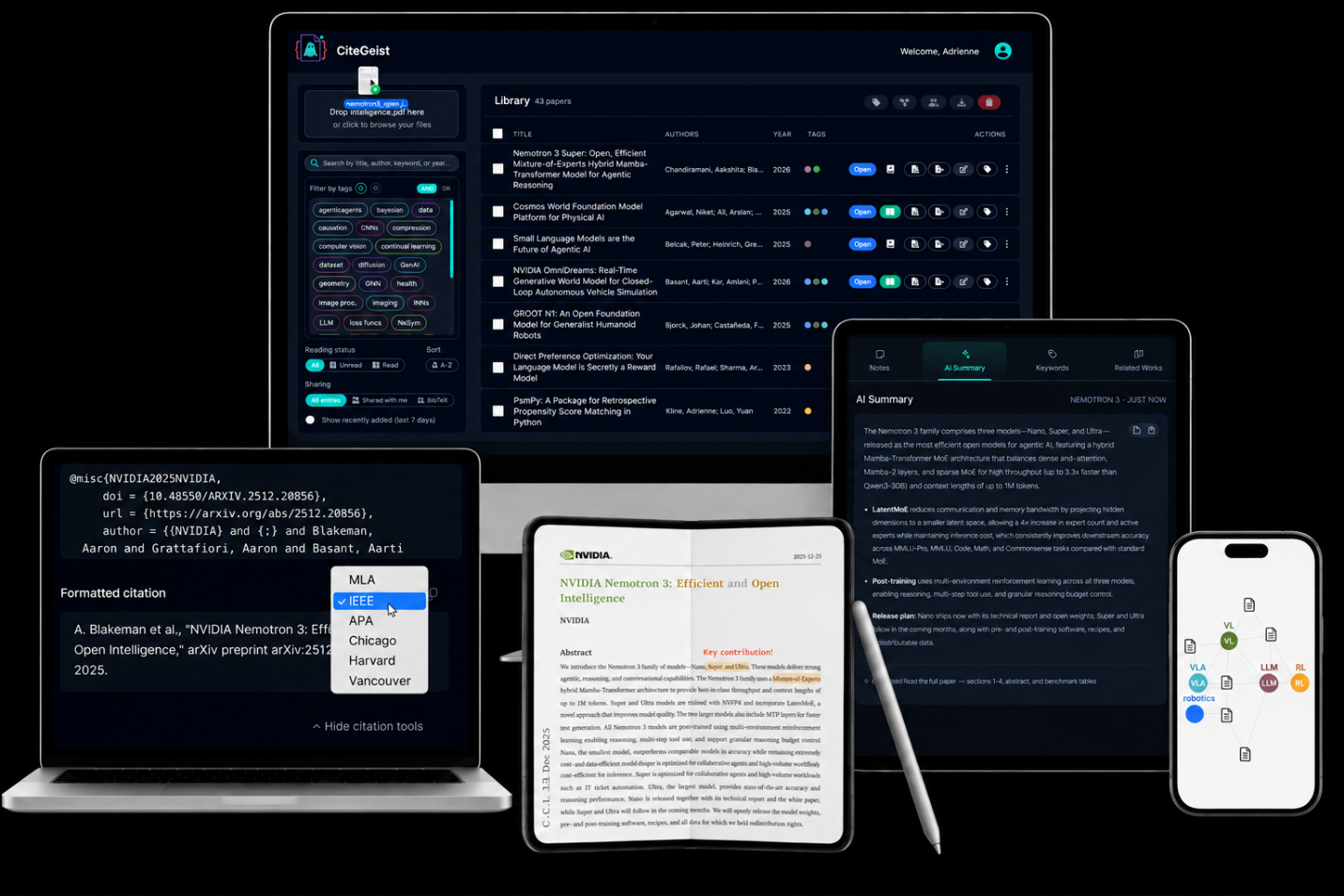
Figure 1: From organizing references to generating AI-powered summaries and verifying citations, CiteGeist streamlines the research workflow across desktop, tablet, and mobile devices
“At the scale we did most of our development, we probably could have run CiteGeist on a Raspberry Pi,” said Kuehn. “Now that we’ve got people using it from all over the world, I’m really glad it’s not running on a little credit-card-sized computer, because AWS infrastructure already solved our scaling problems.”
And the team is just getting started. With several new products in the pipeline, the foundation they’ve built on AWS is helping them move beyond their initial offerings and tackle an even broader range of challenges in healthcare and research. The next wave of products reflects the team’s ambition to rethink how longstanding problems get solved. These products bring ideas from concept to reality at a speed and scale that would traditionally require far greater resources.
More time for science
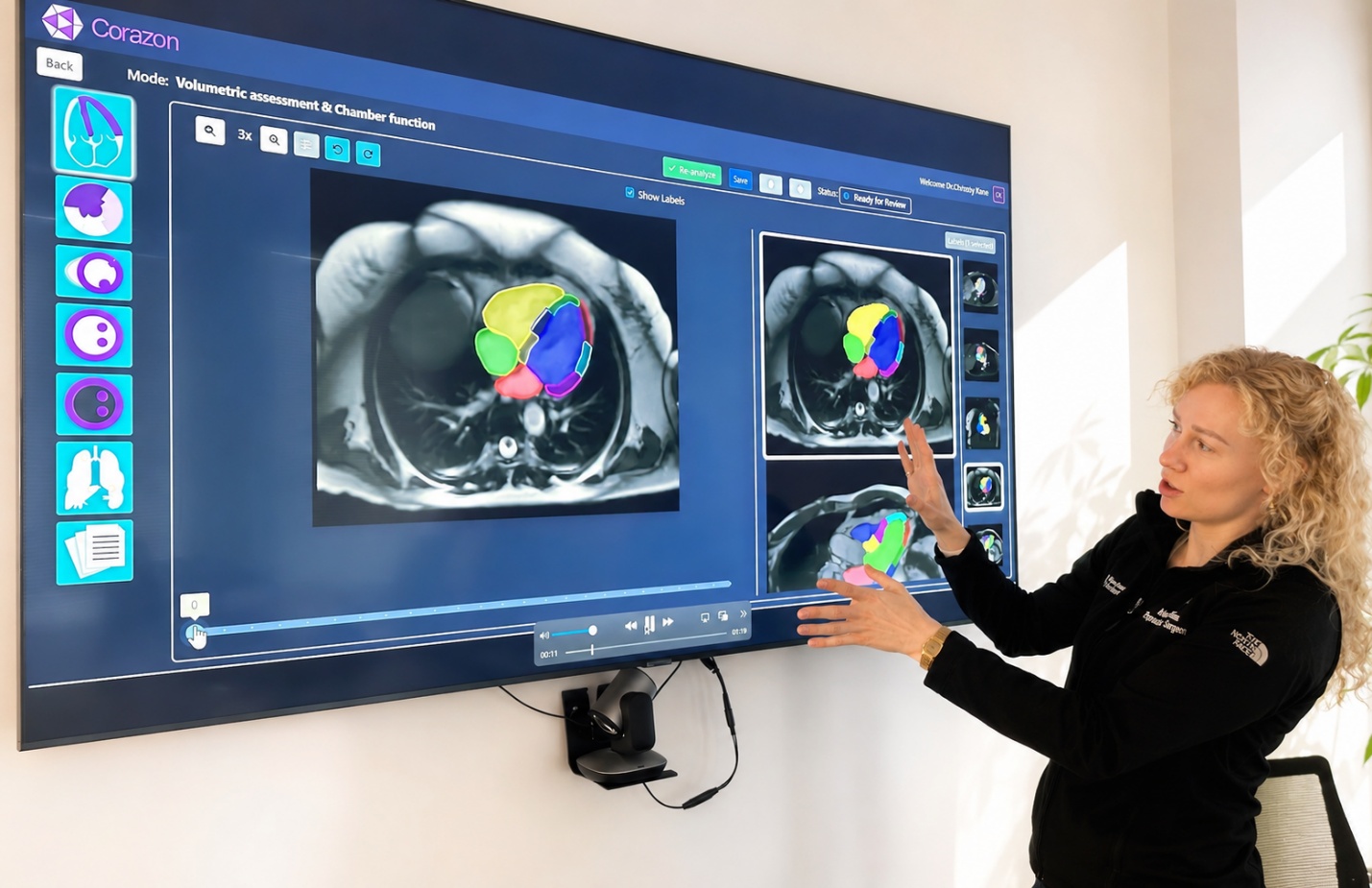
Figure 2: Dr. Adrienne Kline demonstrates an AI-powered cardiac imaging platform designed to advance cardiovascular research and clinical analysis
Across all three tools, the time researchers get back goes toward scientific discovery instead of tedious, error-prone work. Reducing the risk of a PHI exposure or a retraction matters just as much, for institutions and for the researchers whose reputations rest on their work. Looking ahead, Xtasis is expanding its portfolio by offering research verification tools for reviewers and journals. It is also developing imaging-quality enhancement and cardiac-modeling technology that extends its impact further along the patient care journey.
For researchers who see a problem in their field and wonder whether to build the fix themselves, Kline’s advice starts with this mindset:
“I always come back to the idea that innovation starts with the audacity to imagine something others think can’t be done,” she said. “I don’t pretend to have all the answers. But together, we have a team with diverse expertise, a willingness to challenge conventional thinking, and the curiosity to build differently. There’s a difference between blind ambition and informed conviction. For us, it’s about pairing bold vision with discipline and creative persistence.”
From there, find your own enterprising technologist and your own ScaleCapacity. Reach out to AWS and consider an AWS Partner to turn an idea into a proof of concept.
Read related stories on the AWS Public Sector Blog
- How Pariveda built real-time clinical voice notes for Henry Schein One using Amazon Nova and Amazon Bedrock AgentCore.
- How ITHAKA built an on-demand PDF remediation pipeline on AWS.
- Architecting HIPAA-compliant AI agents to safeguard health data with AWS.