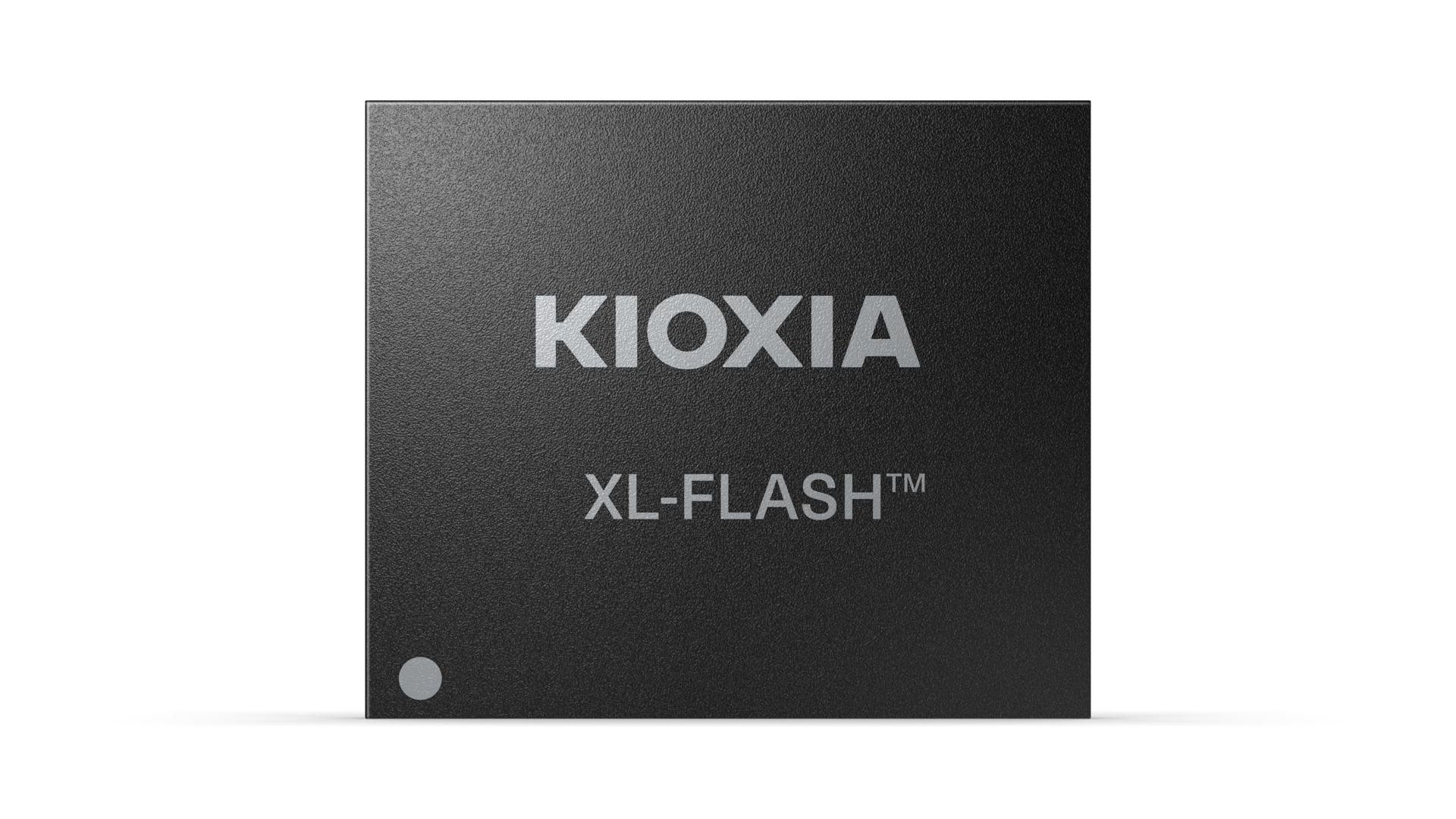
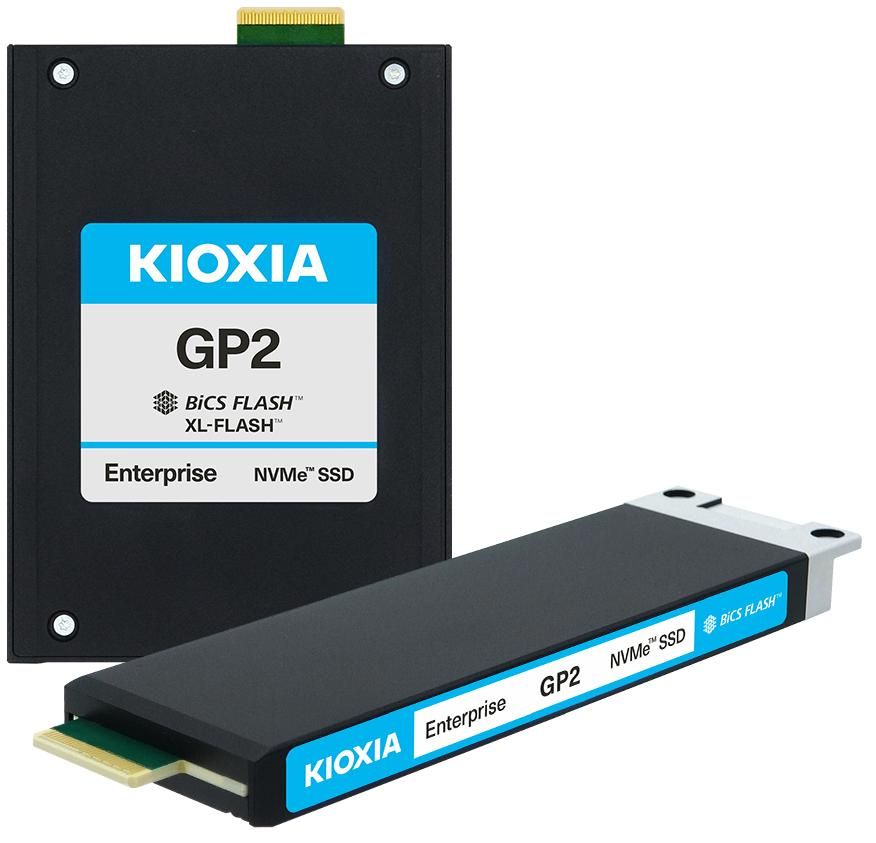
The Kioxia Corporation showcased a prototype of its new XL-Flash Generation 3 technology, next-generation low-latency, high-performance flash memory, at its KIOXIA Forum in Tokyo. The flash, which uses CMOS directly Bonded to Array, or CBA, for better power efficiency and storage density, is about 135% more efficient with 70% higher bit density than Gen 2, and its 3 µs average read latency is less than 10% of that of Kioxia’s standard BiCS8 TLC. Samples are due March 2027, and Kioxia named its GP2 enterprise SSDs, rated for more than 18 million 512-byte random read IOPS, as its first product using it.
The low-latency XL-Flash fills “a new memory tier” to bridge the gap between DRAM and regular flash memory, in a way that can complement or replace some DRAM to help drive down costs, especially in AI servers and data centers. This has some similarities to Optane, which used 3D XPoint instead, as a storage class memory (SCM) option to reach higher IOPS. Intel and Micron’s 3D XPoint stored bits as changes in the cell material’s resistance rather than as trapped charge like NAND, and Intel exited the Optane business in 2022. The XL-Flash NAND is built on BiCS flash technology, but it’s tuned for low read latency and high write endurance.
The first generation was SLC with under-5 µs reads, arriving in 2019. By 2022, Gen 2 added 2-bit MLC as an option for lower bit cost, trading some like-for-like performance for better price-to-density. Gen 3 is reported to use SLC, and its 3 µs average read latency challenges the first gen’s sub-5 µs rating while being more than ten times faster than the 40 µs of standard BiCS8 TLC. This is within the same ballpark as Optane SSDs. The flash also reportedly has SLC endurance at 150,000 to 250,000 P/E cycles, at least 50x standard TLC, running at a 4.8 Gb/s interface speed.
Year | Cells | Die | Read latency | |
|---|---|---|---|---|
Gen 1 | 2019 | SLC | 128Gb | under 5 µs |
Gen 2 | 2022 | SLC or MLC | 128Gb / 256Gb | under 5 µs (SLC), under 10 µs (MLC) |
Gen 3 | 2026 prototype | SLC (reported) | 128Gb (reported) | 3 µs (average) |
BiCS8 TLC | 2023 | TLC | 1Tb | 40 µs |
XL-Flash achieves lower latency, in part, by using more, smaller planes (16 per die, with a 4KB page, on earlier generations), which is common with SLC and low-latency flash, and especially helps with smaller I/O. Kioxia’s GP drives target 512B accesses rather than the typical 4KB, a pattern that matches developments in enterprise storage requirements for AI and other emerging workloads that involve constant fine-grained memory lookups. 3D XPoint would outmatch it for write performance, though, due to not needing to erase for new data.
The newer gen is able to maintain high levels of performance at much higher density thanks to CBA bonding, where Kioxia makes the logic CMOS wafer and flash memory-cell wafer separately and later bonds them. This technology also improves the efficiency of 512-byte reads, by Kioxia’s own tests, which matches the design intention of the forthcoming GP2. Kioxia hasn’t disclosed full details on the flash, such as layer count.
The GP2 Super High IOPS SSD will be Kioxia’s first product to use the new flash, promising high levels of performance, including up to 28 GB/s sequential reads, if it can saturate PCIe 6.0 x4 as expected. Kioxia’s 2.5x IOPS number, versus “typical TLC-based SSDs,” comes from a comparison to its own CM10 drives, for 512B I/O. Endurance will also be excellent at up to 50 drive writes per day, which is within the ballpark of Optane storage.
Kioxia is considering E1.S and E3.S form factors, and the drive will support direct liquid cooling, which is increasingly necessary for certain data centers, including GPU-heavy ones where the GP2 is likely to operate.
These drives will serve as a flash tier to help get more out of a GPU’s HBM, and Kioxia first showed the GP series with Nvidia earlier this year. Offloading memory by any means possible is becoming a strategy with AI, even at the enthusiast level, due to high memory demands and how the technology and its KV caching work.
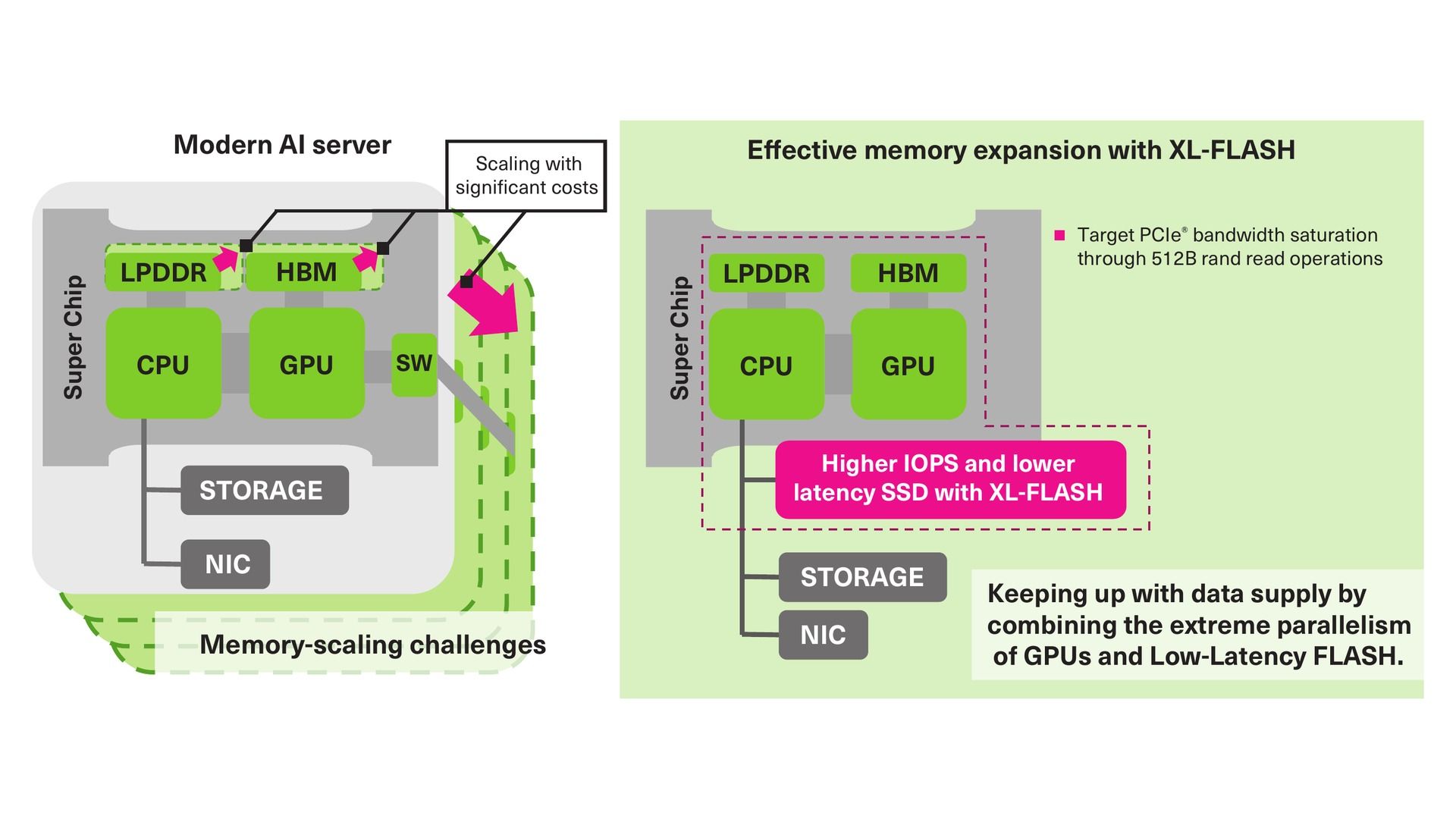
While the flash should sample to select customers before the end of the first quarter of 2027, Kioxia only promises GP2 evaluation samples to select customers by the end of that year. Exact specifications for the drive may differ, but what is clear is that later GP drives will target up to 100 million random-read IOPS that Kioxia and Nvidia have been working toward for AI servers. Kioxia announced its XL1 series of CXL memory expansion modules on XL-Flash in August, and it “will continue to leverage the speed, power efficiency, and endurance of XL-FLASH” for emerging data center needs.