AI & ML
Representation Learning with Quantum Signal Processing
arXiv stat.ML0 views
arXiv:2608.28828v2 Announce Type: replace-cross Abstract: Representation learning begins when training changes the features that define similarity between data. A frozen-kernel model only reweights a fixed geometry. We establish quantum signal processing (QSP) as a solvable quantum model of the representation-learning regime. At arbitrary depth, we compute the exact mean and variance of its quantum neural tangent kernel, revealing an input-dependent angular geometry whose diagonal remains non-self-averaging even when the underlying unitary approaches Haar randomness. We also prove a sparse-data guarantee for the full nonlinear gradient flow without freezing or ensemble-averaging the kernel: the realized dynamics converges to an integrable scalar flow with a time-dependent kernel closure and explicit convergence times. A finite-depth speed limit holds for every data set and trajectory. At higher data density, numerical results show coupled evolution beyond both the scalar and frozen-kernel descriptions. These results give a controlled theory of learned quantum data geometry with provable training dynamics beyond the frozen limit.
Source:https://arxiv.org/abs/2608.28828PreviousFoundCause: A Foundation Model for Causal Discovery with Latent Confounders from Observational DataNextThe Impact of Scenario Representation in Scenario-based Optimization Certification
Related posts

How AUMOVIO centralized AI access with Databricks Unity Gateway
0Databricks Blog

What's new for Genie in Microsoft: Copilot Cowork and Chat, Microsoft Teams, and Excel.
0Databricks Blog

Introducing Unity Gateway Insights
0Databricks Blog

Shadow AI Is Shipped to You, One Release Note at a Time
0Imperva Blog

Our Approach to Updating Our Commercial Terms of Service
0Meta Newsroom
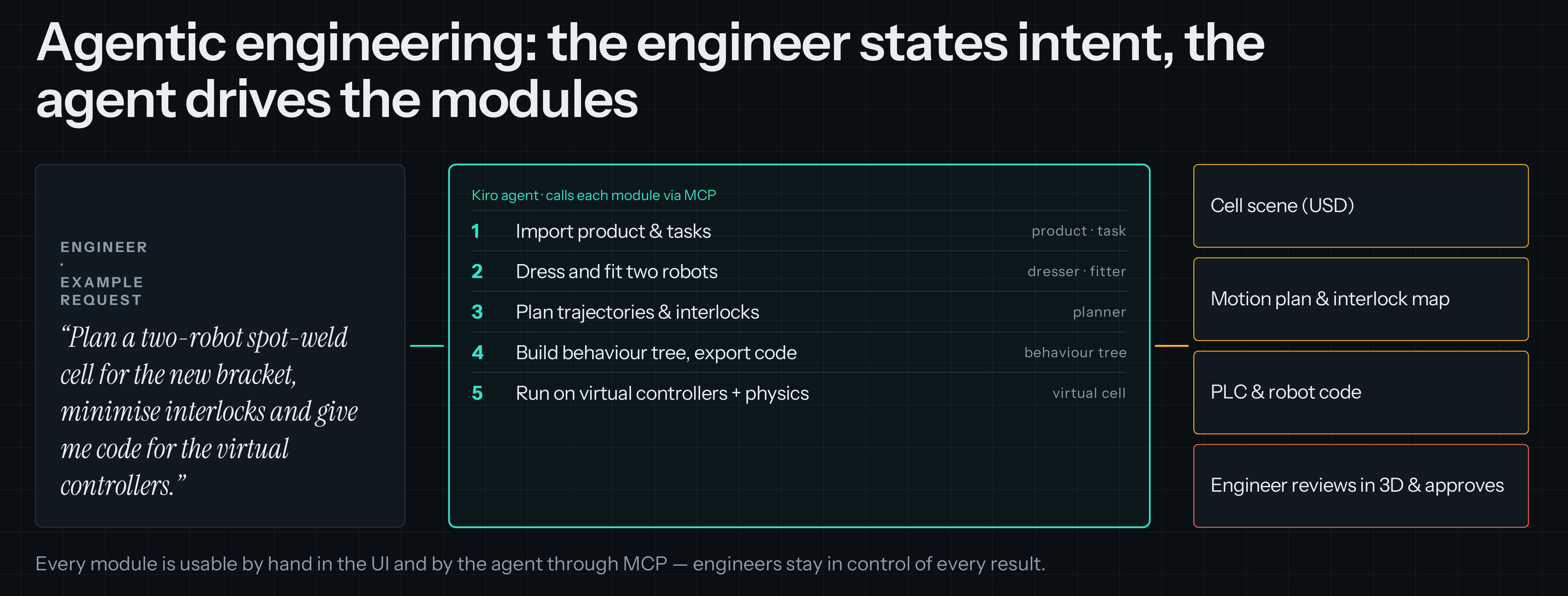
Physical AI Production Designer: Cell Programming from Weeks to Hours
0AWS for Industries