Leading semiconductor research firm SemiAnalysis believes that Jensen Huang's sudden departure from Nvidia may have been driven not only by revelations about his personal extramarital relationships, but also by widespread illicit exports of advanced AI accelerators to China. In its latest newsletter, analysts estimate that more than 1.5 gigawatts (GW) worth of restricted Nvidia hardware, which could be equivalent to up to 1.5 million GPUs, has reached the country despite U.S. export controls.
- While the U.S. flip-flops on chip sanctions, China is building its own chip supply market
- The state of China's decade-long semiconductor push
- Huawei Ascend NPU roadmap examined
- China's CXMT targets 30% DRAM memory market share by 2030 with sixth mega-fab
- China's latest round of rare-earth export controls explained
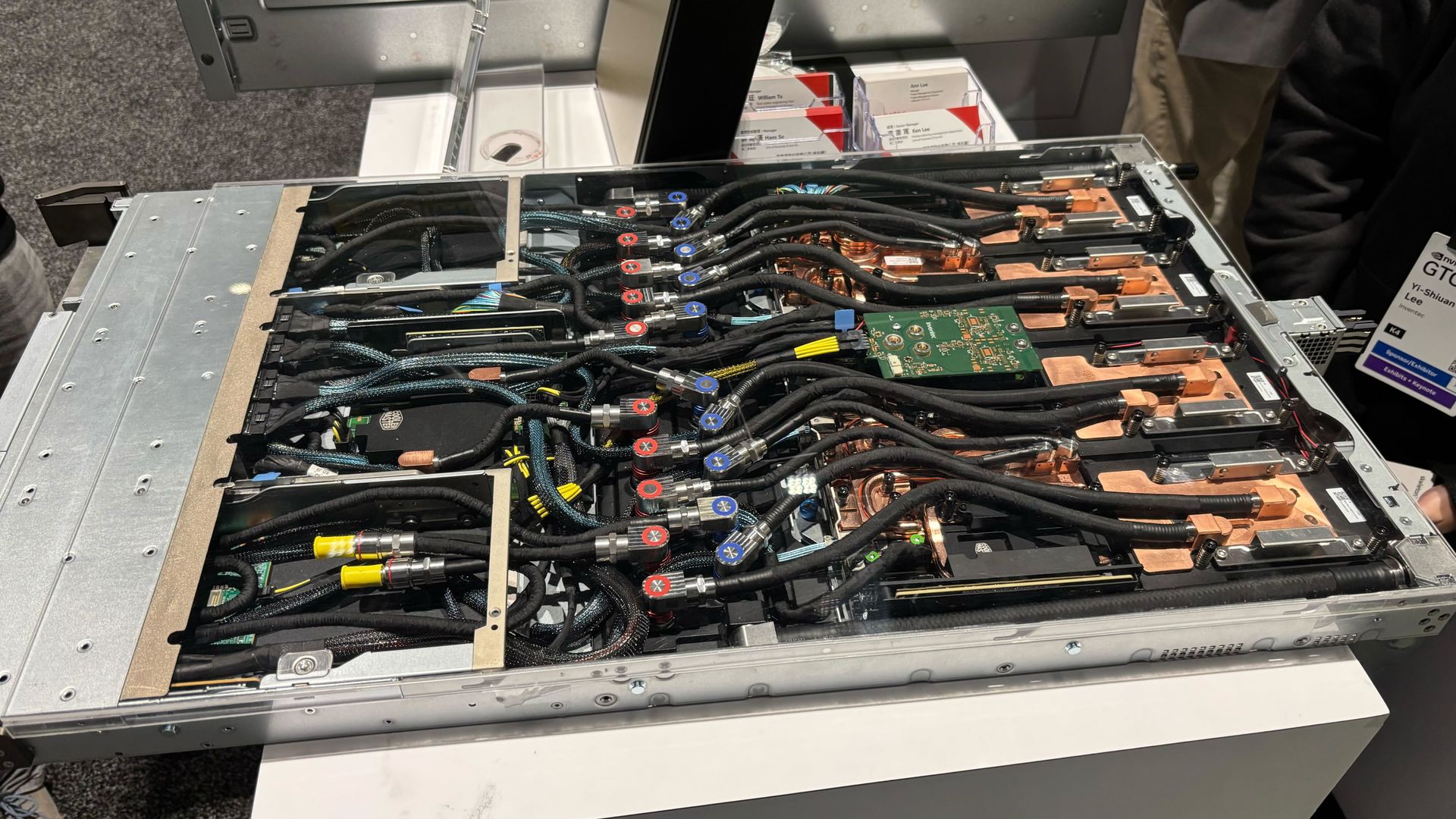
Over 1.5 GW of Nvidia hardware subject to U.S. export restrictions ultimately ended up in China in recent years, according to SemiAnalysis' Accelerator Model, which tracks AI accelerator production and destinations. The estimate excludes processors that Nvidia specifically developed to comply with U.S. export rules, such as the H20 or H800. The firm also claims that the U.S. Department of Commerce has reached a similar conclusion about the scale of unauthorized shipments. Yet, SemiAnalysis does not disclose the exact number of accelerators shipped to China illegally, or their split between Nvidia's product generations.
The scale of the alleged diversions is particularly notable because modern AI accelerators require substantial power and infrastructure. While the report does not explain how it converts accelerator quantities into power figures, it is likely that the company uses package-level nameplate/rated power multiplied by the number of GPUs. Assuming that all of these AI GPUs were Nvidia H200 SXM rated for up to 700W, then China got around 2.142 million of such accelerators, while if all of these processors were B200 SXM rated for up to 1,000W, then we are talking about 1.5 million units. For a mixed deployment, the total would fall between these figures, depending on the proportion of H200 and B200 accelerators. To put these numbers into context, xAI's Colossus One had 220-230,000 Hopper H100 and H200 GPUs, whereas the Colossus 2 has a target of 1.2 million Blackwell B200 and B300 GPUs. That said, 1.5 GW of restricted Nvidia hardware in China represents an enormous amount of computing infrastructure, which is comparable, or even exceeds, the scale of xAI's entire existing Colossus operation.
While SemiAnalysis did not reveal all the cases in which restricted AI accelerators reached the People's Republic of China, it supports its assessment with two well-known cases of alleged GPU smuggling. The first involves Supermicro co-founder Wally Liaw, Taiwan sales executive Steven Chang, and contractor Willy Sun, who were charged in March 2026. According to the indictment, approximately $2.5 billion worth of servers were sold to a company in Southeast Asia, with $510 million worth of equipment subsequently diverted to China and obtained by Alibaba. Prosecutors allege that the defendants used substitute servers and transferred identification labels to conceal the actual destinations of the hardware during audits.
The second case involves nine individuals associated with Nvidia, Albatron, Chief Telecom, Flying Tiger, and Supermicro in Taiwan. The authorities accuse the group of arranging unauthorized exports of 130 Nvidia B300-based servers, 74 of which eventually reached China. The suspects used shell companies, forged documents, and declared Japan as the destination for servers that were actually bound for China, according to prosecutors. Taiwanese authorities discovered the operation during a drug smuggling investigation. Both cases are still before the courts.
Amidst the ongoing fallout and reports into Jensen's Huang's extramarital affair with Alice Huang, an alleged Chinese intelligence asset who was an executive at Megaspeed, one report claims that Ms. Huang was personally responsible for facilitating the smuggling of $7.5 billion of Nvidia AI hardware into China, around 240,000 GPUs, mostly H100 and H200 models.
The right timing?
SemiAnalysis suggests that the scale of these violations may explain why Huang's personal conduct became a major issue at this very point in time. The company's analysts speculate that some members of the U.S. intelligence community sought to remove Jensen Huang because he opposed more aggressive restrictions on China's access to American AI hardware. However, the report provides no direct evidence that intelligence agencies influenced Nvidia's board or that Huang participated in unauthorized exports.
The timing also coincides with congressional efforts to advance the Remote Access Security Act (RASA), which passed the House of Representatives on January 12. The legislation is meant to extend U.S. export-control authority to remote access to advanced AI hardware hosted outside China, including data centers in Europe and the Middle East. SemiAnalysis reports that Nvidia and Oracle have actively opposed the proposal.
The analysts believe that Huang's departure essentially removes an influential opponent of stricter restrictions and accelerates efforts to block Chinese companies from accessing American AI hardware in the cloud. However, SemiAnalysis warns that truly all-inclusive restrictions could encourage Chinese developers to adopt domestic accelerators (something that Jensen Huang has consistently warned about), undermine international AI software collaboration, and ultimately weaken American high-tech companies.
Continued Chinese access to American AI accelerators offers several advantages to the U.S. technology industry, according to SemiAnalysis. Firstly, it generates revenue for American companies such as AMD, Nvidia, and cloud service providers. Secondly, when Chinese companies rent GPU capacity from data centers outside China, U.S. authorities retain the ability to monitor their activities and potentially terminate access if necessary due to national security concerns. Thirdly, prolonged reliance on American hardware reduces incentives for Chinese developers to adopt domestic AI accelerators, which could eventually compete with AMD and Nvidia in international markets.
Another important aspect is the contribution of Chinese developers to the global software ecosystem. On the one hand, Chinese laboratories have developed open-source technologies such as DeepEP, DeepGEMM, and MSA, which improve the efficiency of AI workloads on Nvidia hardware and benefit developers worldwide. In addition, American companies also depend on Chinese engineers, component suppliers, and manufacturers. Therefore, legal curbs that completely restrict Chinese developers' access to American AI accelerators could undermine international cooperation, reduce availability of open-source optimizations, and encourage Chinese companies to develop software specifically for domestic hardware.
On the other hand, access to advanced AI accelerators from AMD or Nvidia enables Chinese laboratories to develop increasingly sophisticated AI models, which will rival leading-edge models developed in America and perhaps create national security risks. To that end, SemiAnalysis acknowledges the need to limit China's access to advanced AI accelerators from U.S.-based companies, as they could, among other things, be used to develop weapons of mass destruction or undermine American national security in different ways. Yet, SA analysts argue that restrictions should focus on the amount and capabilities of hardware available to Chinese entities rather than completely prohibit any access.
SemiAnalysis seems to favor a system in which Chinese developers can rent computing capacity from trusted providers outside China under U.S. oversight. Such an approach could preserve American technological influence and commercial benefits and limit China's ability to acquire advanced AI infrastructure independently.


