
A server card is a small JSON document that a remote MCP server publishes so that a client, a registry or a gateway can learn about it before connecting. The working group behind the Server Card extension settled on a card that names the server, its endpoints and its protocol versions, and deliberately lists no tools: tools can vary per caller, and tools/list on a live connection is the source of truth. Issue #30 asks to bring an optional tool list back for consumers that never connect, such as registries, developer portals and orchestrators planning routes. The group plans to revisit it this month.
Thousands of servers already publish such a list, in an earlier draft of the card format or in formats of their own. HISTOR, the log of MCP tool definitions we run, reads those cards next to the servers themselves, so the question behind #30 can be answered with data: when a card lists tools, does it describe what the server serves?
On 28 November HISTOR had both lists for 1,743 endpoints on 1,601 hosts. 639 cards (36.7%) describe a different tool set than the server serves. In 485 of them (27.8%) the difference is in tool names, description text or parameters; the other 154 differ only cosmetically.
Reading a card and a server the same way
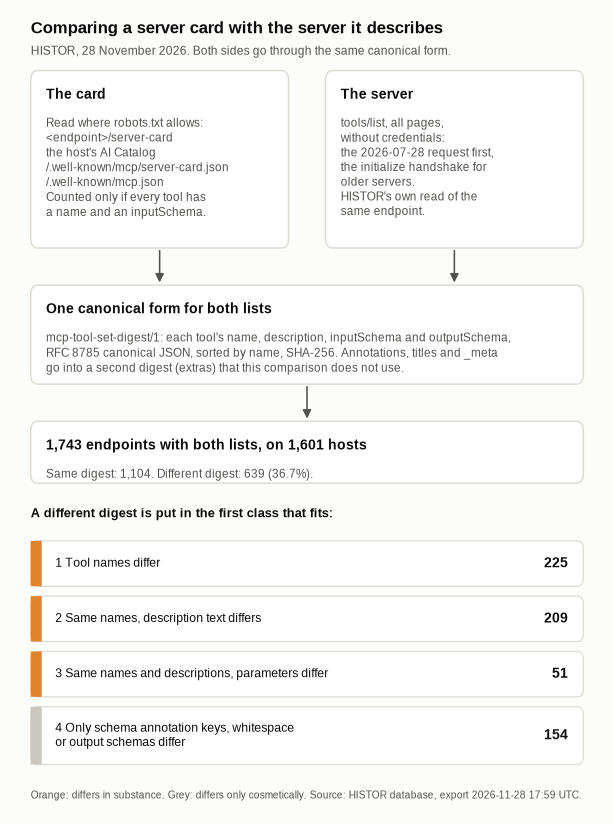
HISTOR looks for a card in four places, and only where the site's robots.txt allows it: the endpoint's own <endpoint>/server-card, which is where the extension now recommends putting it; the cards listed in the host's AI Catalog; /.well-known/mcp/server-card.json; and /.well-known/mcp.json, which no specification names but many sites use. A card counts as a tool list only if every tool in it has a name and an inputSchema. A card that names its endpoints describes those endpoints. One that names none describes the endpoint whose path it extends, or the host's only endpoint. Each card is read at most once a day.
The server side is HISTOR's ordinary read of the same endpoint: tools/list with every page, no credentials, the 2026-07-28 request first and the initialize handshake for servers that need it.
Both lists then go through mcp-tool-set-digest/1, which we co-edit with CrawlCheck: each tool's name, description, inputSchema and outputSchema as RFC 8785 canonical JSON, sorted by name and hashed with SHA-256. Annotations, titles and _meta go into a second digest, extras, which this comparison leaves out. Equal digests mean the card and the server describe the same contract. When the digests differ, the two lists are compared tool by tool, and the pair goes into the first class that fits: tool names, then description text, then parameters, then the cosmetic rest.
The count
| endpoints | share | hosts | |
|---|---|---|---|
| card and server agree | 1,104 | 63.3% | 994 |
| card differs | 639 | 36.7% | 615 |
| … in names, description text or parameters | 485 | 27.8% | 465 |
| … only in annotation keys, whitespace or output schemas | 154 | 8.8% | 151 |
The differences are spread thin. The 639 differing endpoints sit on 615 hosts; the largest single host has seven of them, the next one four. Card and server are read on different schedules, so a server that changed this morning shows as a difference until its card is read again. Counting only servers HISTOR read successfully in the last two weeks gives 519 of 1,561 (33.2%), 374 of them substantive (24.0%).
Our first pass over cards, on 2 November, found 49 of 137 comparable cards different (36%). The set is now 13 times larger and the share has not moved.
What differs
| class (the first that fits) | endpoints |
|---|---|
| same tool names, description text differs | 209 |
| the card lists tools the server does not serve | 77 |
| the server serves tools the card does not list | 74 |
| no tool in common | 44 |
| some tools added, some missing | 30 |
| same names and descriptions, parameters differ | 51 |
| only the server has output schemas | 85 |
input schemas differ only in $schema, additionalProperties, title, description, default or examples | 61 |
| output schemas differ | 6 |
| descriptions differ only in whitespace | 2 |
Description text is the largest class, and the typical case is a card that carries a shorter or older wording of the same tool. Three examples from the data, with the host left out:
-
check_balance: the card says "Check the account balance in USD."; the server says "Return the account's current balance in USD. Takes no parameters." -
get_latest_research: the card promises articles "across all categories"; the server's description does not. -
get_order_status: the card's description ends with "(free)"; the server's does not.
The last one is why this matters beyond tidiness. A description is what a model reads when it decides whether to call a tool, and a client that showed its user the card showed a price claim the server does not make. HISTOR never saw any of these three servers serve the card's wording, so the data does not say which side changed.
Name differences are often a single tool: 27 of the 74 cards that miss tools miss exactly one, and 12 of the 77 cards with extra tools list exactly one the server does not serve. Some are renames. One translation server's card lists translate and list-all-translations, while the server serves translate-tool and list-all-translations-tool. 47 differing cards list a set that HISTOR saw the same server serve earlier: the server moved on and the card stayed behind.
The cosmetic classes look like generated schemas on one side and hand-written ones on the other: $schema and additionalProperties: false on the server's schemas but not the card's, or an outputSchema that the card never had.
Where the card lives predicts how well it matches
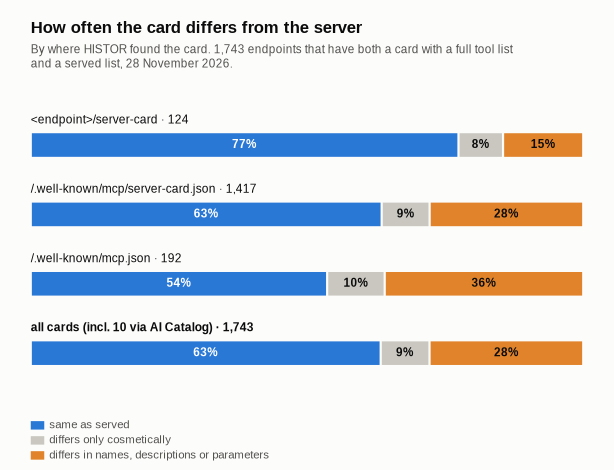
| card path | endpoints | differ | in substance |
|---|---|---|---|
<endpoint>/server-card | 124 | 28 (22.6%) | 18 (14.5%) |
/.well-known/mcp/server-card.json | 1,417 | 517 (36.5%) | 394 (27.8%) |
/.well-known/mcp.json | 192 | 89 (46.4%) | 69 (35.9%) |
| through an AI Catalog | 10 | 5 | 4 |
We did not measure why. A plausible reason is that a card at the endpoint's own path is more often produced by the server process from the same tool definitions it serves, while a file under /.well-known is more often written by hand or by a build step and then left alone. If that is the cause, it argues for cards the server generates, and for a cheap way to check the ones it doesn't.
Checking a card yourself
A card that lists tools has a top-level tools array, and the reference implementation of mcp-tool-set-digest/1 reads it directly, the same way it reads a tools/list response. For a server that answers the 2026-07-28 revision, this is enough (curl, and Python 3.9 or later for the reference file):
curl -sO https://raw.githubusercontent.com/alexar76/mcp-tool-set-digest/9124b2d071e546818b21f4768a90adb87f7f44ab/implementations/python/tool_set_digest.py card=https://calculatorlib.com/mcp/server-card endpoint=https://calculatorlib.com/mcp # What the card says the server offers curl -s "$card" | python3 tool_set_digest.py # What the server serves (a 2026-07-28 server answers tools/list without a session) curl -s "$endpoint" \ -H 'Content-Type: application/json' \ -H 'Accept: application/json, text/event-stream' \ -H 'MCP-Protocol-Version: 2026-07-28' \ -H 'Mcp-Method: tools/list' \ -d '{"jsonrpc":"2.0","id":1,"method":"tools/list","params":{"_meta":{"io.modelcontextprotocol/protocolVersion":"2026-07-28","io.modelcontextprotocol/clientCapabilities":{}}}}' \ | sed -n 's/^data: //p; /^{/p' | head -1 | python3 tool_set_digest.py {"contract": "sha256-rcr1IkmPZZFn2ytEhDKc8JSLGfh9lItTORMwv1O7LkU=", "extras": "sha256-wHnFb89waIjNEnm0tTd1uE7dO+zETDRW7Yd5PGdxnYg="} {"contract": "sha256-rcr1IkmPZZFn2ytEhDKc8JSLGfh9lItTORMwv1O7LkU=", "extras": "sha256-EEaJl5jkqOllgy30lIW8s4I/4a5nyQdTNgqbbNva9e8="} Output as of 28 November 2026, 18:13 UTC; the downloaded file has SHA-256 dd526b83…7639b4. The contract digests match, so this card describes the five tools the server serves. The extras digests differ because the server attaches securitySchemes to each tool and the card does not, which is the kind of difference the contract digest is meant to ignore.
The commands do not cover every server. One that only speaks an older revision needs the initialize handshake first, and a list longer than one page needs every page; the reference refuses a page that carries nextCursor. HISTOR does both, and its API returns the card's digest next to the served one:
curl -s https://histor.modelmarket.dev/api/v1/servers/a0e04d01d3b67a03 \ | jq -c '{card: .serverCard.toolSetDigest, served: .server.toolSetDigest}' {"card":"sha256-rcr1IkmPZZFn2ytEhDKc8JSLGfh9lItTORMwv1O7LkU=","served":"sha256-rcr1IkmPZZFn2ytEhDKc8JSLGfh9lItTORMwv1O7LkU="} A digest instead of, or next to, a list
If #30 adds an optional tool list to the card, these numbers suggest it will disagree with tools/list for a quarter to a third of the servers that publish one. The extension already says, under "Consistency with Runtime Behavior", that a card SHOULD NOT contradict what the client sees once connected. A consumer has no cheap way to notice when it does. A digest of the tool set in the card would give it one:
- Next to a list, a client that connects hashes
tools/listand knows at once whether the card described what it got. An offline consumer can tell whether two cards describe the same set. - Without a list, a server that will not publish its descriptions still commits to its set. A gateway is the usual case: for it a static list is reconnaissance material, and every description a place to plant instructions.
In a card's remote it could look like this (the values are our own weather server's):
"toolSetDigest": { "spec": "mcp-tool-set-digest/1", "contract": "sha256-RCJXRPTiLGIRKcysKzXRNIXUd3TvQb7gxi5/1DQCCZc=", "extras": "sha256-u8cIZySEXq4wDZVx20rtHmlBV4qWQ2sww8vzei1Yo5k=" } The same object is already in bcrypto0's signed add-on declarations, and the value can sit in a registry entry's publisher-provided metadata, so a card, a registry entry and a declaration could share one definition. It has to be a digest a consumer can recompute. That is why the Definition Tags draft in the transports working group does not cover this case: its tags are opaque by design and only compared for equality. A server can still use the content digest as its tag. We are bringing these numbers and this field to the discussion in #30.
Limits
- HISTOR reads without credentials. A card that lists tools only an authenticated caller gets counts as a difference. That can explain part of the 225 name differences, not the 209 description changes.
- Card and server are read on different schedules; the two-week figure above shows how much that moves the share.
- Which card belongs to which endpoint follows HISTOR's rules. A host-wide card on a host with several endpoints counts only for the endpoints it names.
- The cards measured here use formats from before the extension's final schema, or formats of their own. The current card lists no tools, so none of this says anything about cards written to it.
Data
The per-endpoint CSV (both digests, the class and the dates for all 1,743 endpoints), the summary, the export query and the comparison script are at histor.modelmarket.dev/datasets/server-cards-vs-served-2026-11-28. The figures are drawn from the summary by make_figures.py (summary).
We run HISTOR and build WARDEN. AI assistance was used for the count, the code, the figures and this article.


