AI & ML
Asymptotically Stable Gait Generation and Instantaneous Walkability Determination for Planar Almost Linear Biped with Knees
arXiv cs.RO0 views
arXiv:2604.12274v2 Announce Type: replace Abstract: A class of planar bipedal robots with unique mechanical properties has been proposed, where all links are balanced around the hip joint, preventing natural swinging motion due to gravity. A common property of their equations of motion is that the inertia matrix is a constant matrix, there are no nonlinear velocity terms, and the gravity term contains simple nonlinear terms. By performing a Taylor expansion of the gravity term and making a linear approximation, it is easy to derive a linearized model, and calculations for future states or walkability determination can be performed instantaneously without the need for numerical integration. This paper extends the method to a planar biped robot model with knees. First, we derive the equations of motion, constraint conditions, and inelastic collisions for a planar 6-DOF biped robot, design its control system, and numerically generate a stable bipedal gait on a horizontal plane. Next, we reduce the equations of motion to a 3-DOF model, and derive a linearized model by approximating the gravity term as linear around the expansion point for the thigh frame angle. Through numerical simulations, we demonstrate that calculations for future states and walkability determination can be completed in negligible time. By applying control inputs to the obtained model, performing state-space realization, and then discretizing it, instantaneous walkability determination through iterative calculation becomes possible. Through detailed gait analysis, we discuss how the knee joint flexion angle and the expansion point affect the accuracy of the linear approximation, and the issues that arise when descending a small step.
Source:https://arxiv.org/abs/2604.12274PreviousDesigning and Validating a Self-Aligning Tool Changer for Modular Reconfigurable Manipulation RobotsNextLLM-Flax: LLM-Generated Rules and Object Guidance for Neuro-Symbolic Task Planning
Related posts

How AUMOVIO centralized AI access with Databricks Unity Gateway
0Databricks Blog

What's new for Genie in Microsoft: Copilot Cowork and Chat, Microsoft Teams, and Excel.
0Databricks Blog

Introducing Unity Gateway Insights
0Databricks Blog

Shadow AI Is Shipped to You, One Release Note at a Time
0Imperva Blog

Our Approach to Updating Our Commercial Terms of Service
0Meta Newsroom
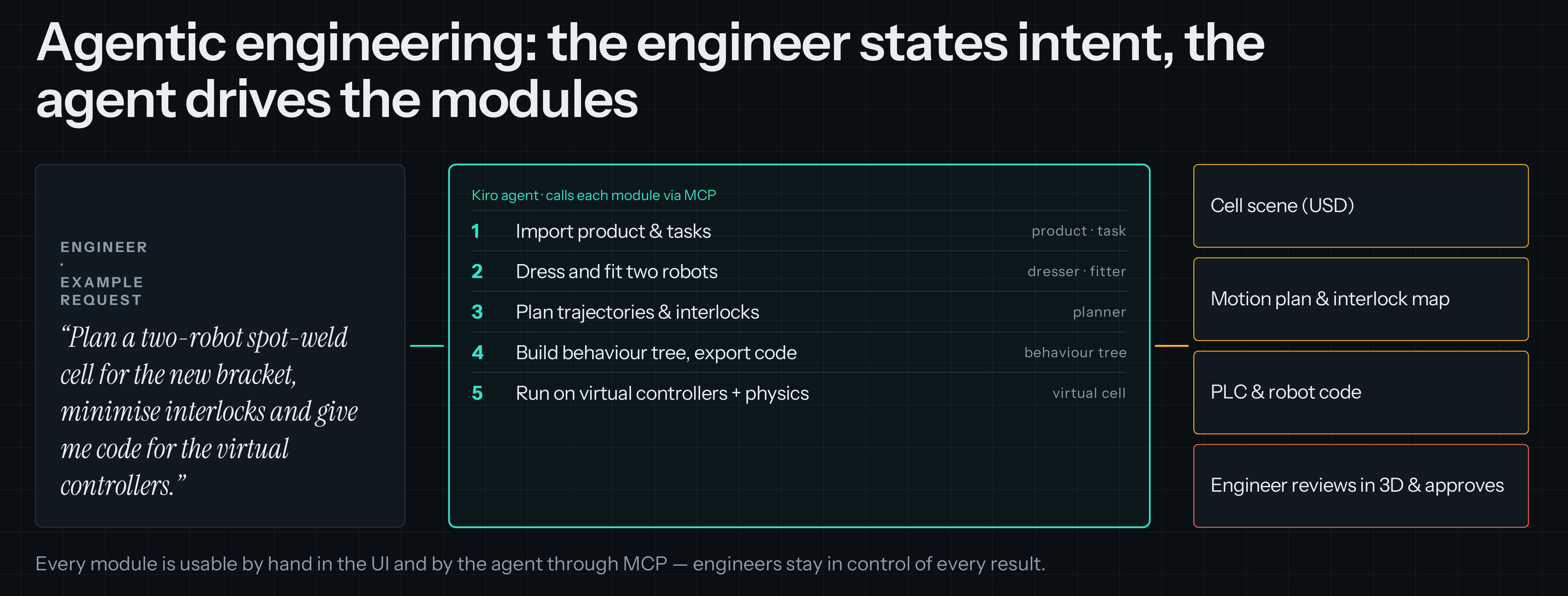
Physical AI Production Designer: Cell Programming from Weeks to Hours
0AWS for Industries